

What if the lowest quoted unit price creates the highest procurement cost? A deeper break can lower per-piece pricing while tying up cash in excess stock or increasing exposure to forecast changes. Effective bulk procurement pricing tier optimization for SMD resistors starts with the demand behind each tier, not the discount alone.
Supplier quotes can be difficult to compare when quantities, replenishment needs, and specifications differ. Assess each tier against forecast demand, inventory exposure, and supply continuity to choose a defensible order quantity without compromising component requirements.
Use a consistent RFQ, compare the full purchasing commitment, and include documentation and authenticity in your sourcing review. Adage Components brings 30+ Years Experience, direct verified procurement channels, and in-person manufacturing audits worldwide to resistor sourcing. We supply authentic components and specification-matched options, including pin for pin replacements with a spec sheet and/or samples. This gives your team a practical framework for balancing cost effectiveness with quality and supply requirements.
Key Takeaways
- Weigh forecast demand, specification control, and sourcing requirements before committing to a bulk pricing tier for SMD resistors.
- Compare quotes using the same part requirements and assumptions. Record the quoted quantity, unit quote, committed quantity, and expected usage.
- Assess single bulk orders, staged releases, and smaller replenishment buys against inventory exposure, demand variability, production continuity, and purchasing workload.
- Build a consistent RFQ with the part number, approved specification, estimated demand, requested tier quantities, and delivery assumptions.
- Use an RFQ or BOM to support a project-specific quote. Adage Components provides authentic components through direct verified procurement channels and conducts in-person manufacturing audits worldwide.
Why SMD Resistor Tier Optimization Is More Than a Lower Unit Quote
A lower unit quote can look decisive on a spreadsheet, but the order behind it may exceed realistic demand, tie up inventory, or fail to reflect the exact component your design requires. Unit-price optimization minimizes the quoted cost per piece; total procurement optimization matches the order commitment to forecast demand, specification control, and sourcing requirements. That distinction is central to bulk procurement pricing tier optimization for SMD resistors.
SMD describes the resistor component and its surface-mount form. SMT, or surface-mount technology, is the assembly process used to place components onto a circuit board. Keeping the terms distinct helps procurement teams focus on the resistor requirement rather than confusing component purchasing with board assembly. For foundational context on resistor types and applications, see Resistor (Wikipedia).
What a bulk procurement pricing tier represents
A supplier may quote different unit prices at different order quantities. Each price break applies to the specific quantities, delivery assumptions, and terms in that quotation. A quoted tier is a price point, not a demand forecast, purchase commitment, or replenishment plan. Treat it as a scenario to evaluate, not an instruction to buy that quantity.
A lower unit quote at a higher tier has practical value only if the committed quantity suits expected use and the component requirements. Keep the same part number and approved specification across quoted options. Otherwise, differences between the parts can make an apparent price advantage misleading.
Why procurement teams need a demand-led comparison
Forecast uncertainty changes the value of a larger order. If production plans shift or expected usage falls, excess committed stock may remain unused. If demand rises, a smaller buy may require more frequent replenishment. The right tier depends on the relationship between the forecast, the purchasing commitment, and the supply plan, not on the discount alone.
Engineering requirements set firm boundaries. Keep the approved part number and specification consistent when comparing tiers; a lower quote for a different requirement is not an equivalent alternative. For a broader framework for balancing cost, supply, and component integrity, see Adage Components’ strategic sourcing guide. A disciplined sourcing approach connects price evaluation with verified procurement channels and authentic components, so cost decisions support production needs without weakening specification control.
How to Compare SMD Resistor Price Tiers Against Real Demand
A useful tier comparison puts each supplier break beside the quantity your operation can reasonably use, not just the unit quote. Keep the part requirements, quotation date or validity, delivery assumptions, and other terms consistent across scenarios. If any differ, record the difference so a changed requirement is not mistaken for a price benefit.
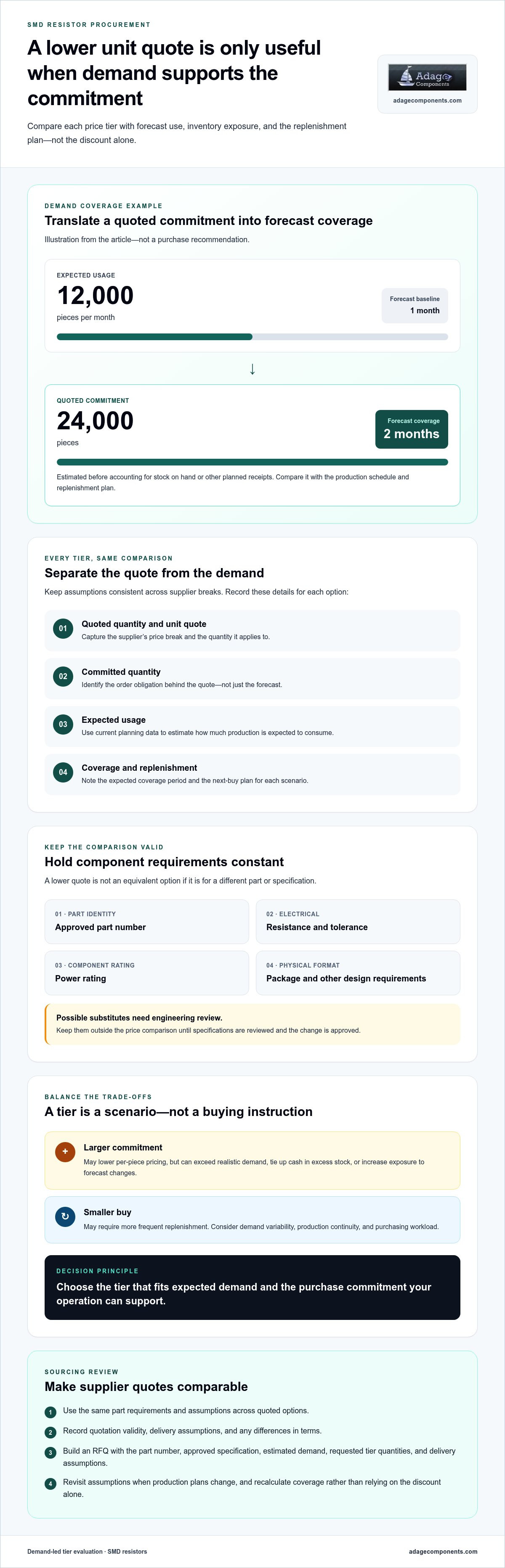
The best tier is the one that fits expected demand and the purchase commitment your operation can support. This demand-led method makes bulk procurement pricing tier optimization for SMD resistors a practical decision rather than a search for the largest discount.
Which SMD resistor requirements must stay constant
Start with the controlled BOM and approved part number. Record the resistance, tolerance, power rating, package, and any other design requirements that apply. Use the same baseline for every quoted tier. A possible substitute is not automatically equivalent. Keep it outside the price comparison until engineering reviews its specifications and approves the change.
How to model order and demand scenarios
For each tier, separate the quantity the quote requires you to commit to from the quantity your forecast says you will use. Add the expected usage period and planned replenishment assumptions. This makes it easier to see whether a tier supports scheduled demand or creates a commitment beyond it.
Use the same assumptions in every row. Fill in the fields with the supplier’s quote and your current planning data:
| Quoted quantity tier | Unit quote | Committed quantity | Expected usage | Coverage and replenishment assumption |
|---|---|---|---|---|
| Tier A | Enter quote | Enter commitment | Enter forecast usage | Enter expected coverage and next-buy plan |
| Tier B | Enter quote | Enter commitment | Enter forecast usage | Enter expected coverage and next-buy plan |
| Tier C | Enter quote | Enter commitment | Enter forecast usage | Enter expected coverage and next-buy plan |
For a simple illustration, if expected usage is 12,000 pieces per month, a 24,000-piece commitment represents two months of forecast coverage before accounting for stock on hand or other planned receipts. That is an estimate, not a purchase recommendation. Compare it with your production schedule and replenishment plan, then note how the picture changes if demand rises or falls.
Keep forecast demand distinct from a purchase commitment. A forecast estimates future use; the committed quantity represents the order obligation in the quote scenario. Revisit the assumptions when production plans change and recalculate coverage rather than relying on an outdated forecast. This gives procurement and engineering a shared basis for reviewing each tier.
For a project-specific comparison, align the approved BOM requirements with the relevant resistor product linecard before evaluating sourcing options.
Bulk Order, Staged Releases, or Smaller Buys: Which Tier Structure Fits?
The order structure determines how a quoted price interacts with inventory, production continuity, and purchasing effort. A larger single order, staged purchasing, and smaller replenishment buys each address different planning needs. None is automatically the best choice. Compare them against the demand profile and the supplier’s quoted terms, including the quantity you commit to and the delivery schedule.
Separate two questions: how much are you agreeing to purchase, and how will that quantity be delivered? A staged release may change delivery timing without changing the total commitment. Treat those details as quotation-specific, not as standard terms. A lower tier price alone does not establish that future supply is reserved or guaranteed.
When a larger commitment may suit the production plan
A larger order may fit when production demand is stable, the component specification is controlled, and the planned quantity is supported by a credible forecast. Consolidating a purchase can simplify ordering and reduce the frequency of procurement transactions. The benefit depends on whether the commitment aligns with expected consumption and your inventory capacity, not simply on reaching a lower quoted tier.
Buying beyond a supportable requirement creates exposure if schedules change, demand falls, or an engineering revision affects the approved part. Assess expected usage alongside existing stock and planned receipts. Keep the tier’s price benefit separate from assumptions about availability: do not treat a bulk quote as a supply guarantee unless the written terms explicitly state the applicable commitment and conditions.
When flexibility may matter more than the lowest tier
Staged purchases or smaller replenishment orders can suit programs with uncertain schedules, forecast changes, or possible design revisions. They may limit the inventory held at once and let purchasing respond as demand becomes clearer. The trade-off is operational: more frequent orders may increase administrative workload, and later purchases remain subject to their own quoted terms.
Evaluate each structure across four practical factors:
- Inventory exposure: How much stock could remain if demand shifts or a revision changes the requirement?
- Demand variability: How reliable is the forecast over the period covered by the proposed commitment?
- Production continuity: Does the purchasing plan support scheduled builds without assuming unquoted future supply?
- Purchasing workload: Can the team manage additional order placement, tracking, and quote review?
Then compare the written terms for each option. Confirm whether the quote covers one purchase or a total commitment with scheduled releases, and record any conditions that affect quantities or timing. Do not assume a staged arrangement offers the same flexibility as smaller independent buys. For bulk procurement pricing tier optimization for SMD resistors, choose the structure that fits supportable demand while keeping inventory risk and production requirements visible.
Build an RFQ That Makes SMD Resistor Tier Quotes Comparable
A strong RFQ gives suppliers the same technical baseline, demand picture, and delivery assumptions. That makes responses easier to compare and reduces the risk of treating a different component or commitment as a like-for-like price option. Identical specifications and quotation assumptions are essential because any difference can distort the comparison between tiers.
Use this workflow to prepare a consistent request for quote:
- Identify the component. Provide the approved part number and controlled BOM reference. Include the approved specification and relevant design requirements, such as resistance, tolerance, power rating, package, and any other applicable parameters.
- Define the demand. State estimated usage and the period it covers. Separate firm requirements from forecast quantities, and note which figures may change with the production plan.
- Request comparable tiers. List the specific order quantities you want quoted. Ask suppliers to show the unit quote, required purchase commitment, and quantity conditions for each tier.
- Set delivery assumptions. State the required delivery timing or schedule assumptions consistently across the RFQ. Ask suppliers to identify differences in delivery terms or conditions rather than leaving them implicit.
- Document replacement requirements. If a pin for pin replacement is acceptable, state that requirement and keep engineering approval in the process. Request a spec sheet and/or samples to support evaluation of a proposed replacement.
- Standardize response fields. Request written responses that identify the quoted part, tier quantities, unit quote, commitment, delivery assumptions, and applicable quotation conditions.
Prepare the technical and commercial RFQ inputs
Build the request from current, controlled BOM data so each supplier receives the same approved component definition. Label estimates clearly and avoid presenting forecast demand as a firm order. If you are submitting a BOM for review, use the BOM submission form to provide project requirements in a structured format.
Evaluate the response without losing quality controls
Compare each quoted tier against the same part requirements and demand assumptions. Then assess sourcing and documentation alongside price. Adage Components focuses on authentic components through direct verified procurement channels and in-person manufacturing audits worldwide. Include specifications, certifications, and delivery claims in the comparison only when they are supported by the supplier’s response and relevant documentation.
For a proposed replacement, keep the original approved part and replacement details distinct in your review. Engineering should assess the supplied specification information and samples before treating the replacement as equivalent for purchasing. This preserves traceability while allowing a controlled evaluation of alternatives.
A consistent RFQ is the working foundation for bulk procurement pricing tier optimization for SMD resistors. Review Adage’s resistor linecard and align your RFQ with the component requirements under consideration.
Put an Optimized SMD Resistor Sourcing Plan Into Action
Put the decision into practice by validating demand, keeping approved specifications consistent, comparing quoted tiers, and assessing inventory exposure before committing. Adage Components is a Canada-based private label manufacturer offering authentic components through direct verified procurement channels. Our sourcing approach includes Thick Film Chip Resistors and pin for pin replacement options supported by a spec sheet and/or samples.
Where Adage Components fits in the sourcing decision
We provide manufacturer pricing through direct verified procurement channels, with international logistics and short lead times. Adage Components conducts in-person manufacturing audits worldwide to support quality assurance. The company describes its sourcing as 20% more economical; evaluate the quote for your specific part, quantity, and requirements to understand the project cost.
What to prepare before requesting a project quote
Bring the relevant BOM, approved resistor specifications, and realistic demand scenarios. Identify which quoted quantities your production plan can support, and note any pin for pin replacement requirement. Adage offers pin for pin replacement with spec sheet and/or samples. Pricing is provided by quote, so project requirements and quantities form the basis for a relevant commercial comparison.
Align your sourcing review with your component requirements and review the component linecard to move your SMD resistor sourcing plan forward.
Make Your Next Sourcing Decision Easier to Revisit
A tier decision should not end when the purchase order is placed. Make it a repeatable sourcing control by recording the assumptions behind the commitment and defining when the team will revisit them, such as after a production schedule or BOM change. That gives procurement and engineering a shared reference for future buys without reopening the entire analysis from scratch.
Use bulk procurement pricing tier optimization for SMD resistors as an ongoing discipline, not a one-time price exercise. As requirements evolve, the next review can start with a clear record of what was approved and which sourcing options fit the program. That continuity helps your team respond to change while keeping component selection grounded in the current design.
To move forward, submit your RFQ or BOM to Adage Components for a project-specific quote, including the resistor requirements, demand scenarios, and requested tier quantities.
Frequently Asked Questions
How should procurement teams choose an SMD resistor pricing tier?
Choose the tier that fits a credible production plan, not simply the largest available quantity. For bulk procurement pricing tier optimization for SMD resistors, check usable stock on hand, when it is needed, and whether the forecast is firm enough to support the quoted commitment. Review the tier if a build schedule or design change shifts demand before the stock is consumed.
How much can bulk SMD resistor pricing reduce procurement costs?
There is no reliable reduction to assume without a quote for the specific part and purchase conditions. Request prices for the same approved resistor at several quantities, then compare the unit quote and total committed quantity alongside delivery terms. A lower unit price can be offset by purchasing more than the program can use. Adage Components provides pricing by quote, so assess costs against your BOM and sourcing requirements.
Can an OEM combine SMD resistor demand across multiple production runs?
Potentially, if the runs use the same approved resistor and the supplier’s quoted terms support a combined quantity or scheduled purchasing arrangement. Keep demand by program or run visible in the forecast, and distinguish the quantity the OEM is committing to from the timing expectations for individual builds. Do not treat separate specifications or uncertain future programs as interchangeable demand without engineering and procurement review.
What information should an SMD resistor bulk procurement RFQ include?
Include the approved part number, controlled specification, forecast quantity, requested quote tiers, and delivery assumptions. Add the intended delivery location, required schedule, and any documentation or traceability requirements your quality process needs. Identify which quantities are firm and which are estimates. A clear RFQ helps suppliers respond on the same basis and gives your team enough information to compare commercial terms while maintaining component controls.
What happens if a lower-tier quote involves a resistor replacement?
Keep the replacement separate from the original part in the comparison until engineering has reviewed and approved it. Compare the proposed part’s documentation with the controlled design requirements, and request a spec sheet and/or samples to support evaluation. If approved, update the BOM or change records so purchasing, engineering, and production reference the same accepted part. A lower quote alone does not establish technical equivalence.
Is the lowest SMD resistor unit price always the best procurement choice?
No. Unit price is only one part of the decision. Consider the quantity you must commit to, how that commitment fits expected use, the quotation’s delivery conditions, and the risk of holding stock that production may not need. A higher unit quote can be a better fit if it aligns more closely with a changing schedule or reduces excess inventory exposure. Compare the full purchasing scenario, not one line of the quote.
Disclaimer
Cross-referenced components needs to be confirmed by the client with either spec. sheet or samples or both.
Please note, we use AI to help us, information is verified to be correct but we can not guarantee 100% accuracy.


