

A matching capacitance and package don’t make two automotive MLCCs interchangeable. An automotive grade MLCC cross reference guide compares the application, dielectric, package, voltage rating, manufacturer series, and AEC-Q200 qualification before treating a part as a candidate replacement. Each parameter affects whether the component fits the design.
That matters when a series changes, a part becomes difficult to source, or a design needs a qualified alternative. A cross-reference is a starting point, not a part-number-only swap: dielectric behavior, operating conditions, and qualification all shape the comparison.
This guide explains how to read manufacturer series and package codes, compare dielectric and voltage ratings, and assess AEC-Q200 qualification for automotive use. You’ll learn which details to align first and where electrical or mechanical differences can affect a replacement decision.
Key Takeaways
- Match manufacturer series and dielectric characteristics, not just capacitance, when identifying possible automotive MLCC alternatives.
- Use package dimensions as well as case codes to avoid footprint mismatches across metric and EIA sizes.
- Treat AEC-Q200 qualification as a key requirement for automotive applications, alongside suitability for the component’s operating environment.
- For multiple part numbers, compare the electrical and mechanical attributes systematically to narrow candidates without assuming similar codes mean equivalent performance.
- Evaluate voltage rating, DC-bias behavior, temperature range, and mounting constraints together before approving a replacement.
MLCC manufacturer series and brand identification
An MLCC part number encodes more than capacitance. Murata, TDK, Samsung Electro-Mechanics, Taiyo Yuden, KEMET, and Walsin use their own series identifiers and ordering conventions. Start by separating the manufacturer, series, package, dielectric, capacitance, tolerance, and voltage fields. This makes it easier to distinguish a genuine candidate from a similar-looking code in an electronic component search.
For Murata, TDK, Samsung Electro-Mechanics, KEMET, or AVX, cross-reference by matching the part’s electrical and mechanical requirements, not by comparing brand names alone. Searching with another manufacturer’s part number can surface candidates, but the result is only a lead. Decode each candidate’s series and compare its attributes with the original component before moving forward.
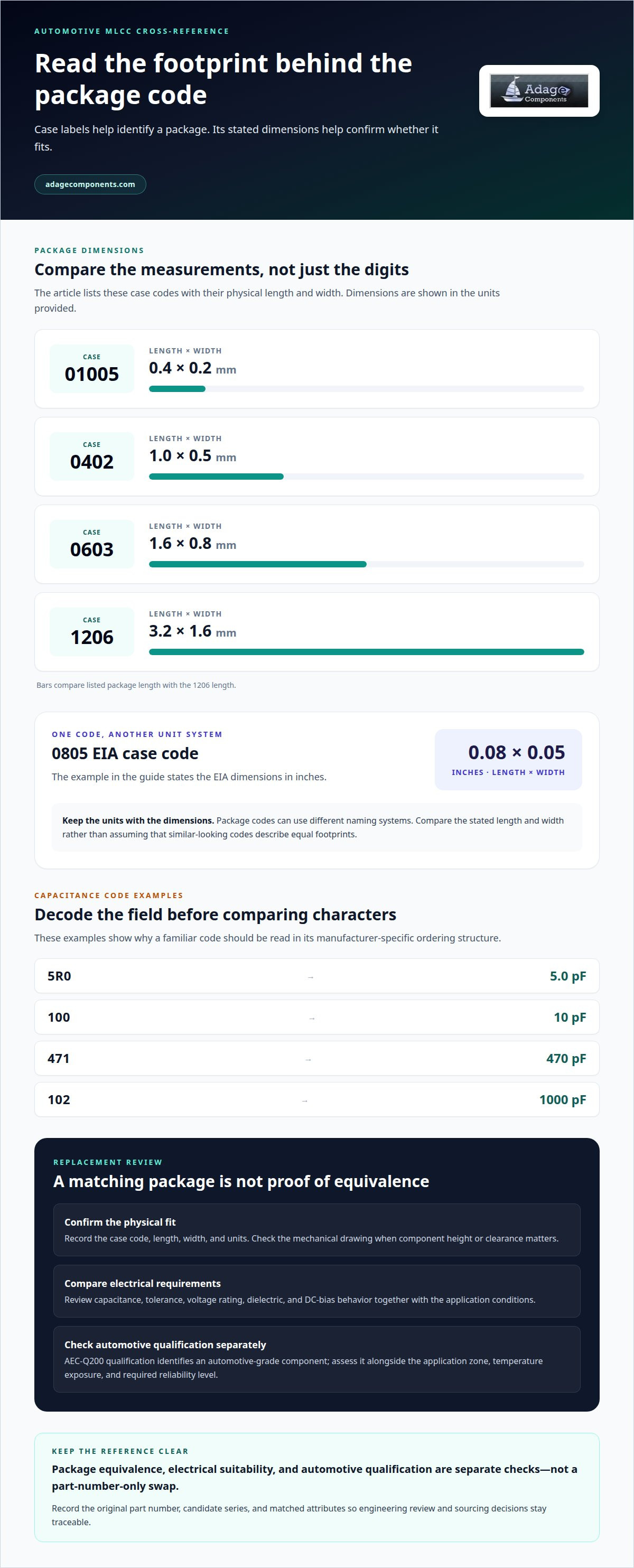
Part-number fields may represent different information across manufacturers. For example, capacitor codes 5R0, 100, 471, and 102 correspond to 5.0 pF, 10 pF, 470 pF, and 1000 pF. A familiar code may still belong to a different field in another series. Read the manufacturer’s ordering structure before treating matching characters as equivalent. This prevents a search from returning a misleading candidate.
Compare the complete component structure as well as its code. An MLCC contains ceramic dielectric layers and internal electrodes, with external terminations connecting those electrodes to the circuit. The farthest BME or Ag/Pd termination layer is stated as 15…40 μm. Differences in termination materials or construction can matter for board attachment and operating conditions, even when package and capacitance appear to match.
Use a consistent cross-reference record for every candidate:
- Manufacturer and series: Record the maker and exact series identifier.
- Electrical values: Compare capacitance, tolerance, voltage rating, and dielectric.
- Package and termination: Match the footprint and relevant construction details.
- Qualification: Keep automotive qualification distinct from a general component match.
Replacing an automotive MLCC based only on a cross-reference can introduce electrical, mechanical, or qualification mismatches. A different dielectric or termination structure may affect performance or mounting suitability. A similar part number does not establish equivalent automotive qualification. Compare the candidate’s specified characteristics with the application before accepting it as a replacement.
This automotive grade MLCC cross reference guide treats manufacturer part numbers as identifiers, not proof of interchangeability. For sourcing decisions, keep the original part number, candidate series, and matched attributes together. That record clarifies engineering review and procurement decisions across Murata, TDK, Samsung Electro-Mechanics, KEMET, AVX, and Walsin alternatives. It also preserves traceability as an electronic component moves from selection into a production record.
Package-size conversions and dimensions
MLCC case codes identify a footprint, but coding systems can differ. Compare the stated length and width before treating two packages as equivalent.
EIA and IEC/EN Case-Size Codes
EIA case codes identify package size, while IEC/EN 60384 references address ceramic dielectric classifications. For example, the EIA case code 0805 corresponds to a component measuring 0.08 inches long by 0.05 inches wide. IEC/EN 60384-1 and IEC/EN 60384-8/9/21/22 help classify dielectrics, not convert an EIA footprint. Keep those functions separate when reading a part specification.
Size Codes and Metric Dimensions
Metric dimensions show the physical length and width behind a package label. A 0402 MLCC is listed as 1.0 × 0.5 mm, while a 0603 is 1.6 × 0.8 mm. A 01005 measures 0.4 × 0.2 mm, and a 1206 measures 3.2 × 1.6 mm. Use the dimensions, not the digits alone, to confirm board fit.
Package-Size Conversions
Package conversion means matching a case code to its actual dimensions across naming systems. The 0805 example converts from 0.08 × 0.05 inches to a metric measurement, while 0402 and 0603 are listed directly in millimetres. Record both the code and units. This prevents a code from one system being mistaken for an equal-sized package in another.
Dimension checks matter at the circuit level. A footprint mismatch can affect pad alignment and placement, even when two MLCCs share a nominal capacitance. Package length and width also don’t describe component height. Read the mechanical drawing when height or clearance affects the design, rather than inferring those details from a code such as 0603.
Keep package equivalence separate from electrical equivalence. A consumer-electronics board and an automotive circuit may use similarly labelled case sizes, but that alone says nothing about dielectric behavior, voltage rating, DC bias performance, or qualification. For example, matching a 0402 footprint doesn’t establish that two capacitors provide equivalent capacitance under operating conditions.
For a sourcing review, capture the original case code, its length and width, and the proposed replacement’s corresponding dimensions. Preserve the measurement units in the record. This makes it easier to spot a label-system mismatch before procurement or layout changes. After fixing the required footprint, the manufacturer line card can help connect package requirements with series sourcing.
Automotive use and AEC-Q200 reliability level
Automotive MLCC selection starts with the application zone, temperature exposure, and required reliability level. AEC-Q200 qualification identifies an automotive-grade component; it does not replace matching its electrical specifications to the circuit. For power-supply decoupling, choose a dielectric based on the circuit’s stability requirements and operating conditions.
Automotive MLCC temperature ratings depend on the component’s specified operating range and placement zone. A suitable maximum temperature rating is 125°C or 150°C, depending on where the component sits. High-temperature X8R and X9M MLCCs are identified for temperatures up to 150°C-200°C. Choose against the expected component environment, not the vehicle category alone.
Temperature codes also describe behavior, not just a maximum value. C0G (NP0) MLCCs operate from -55 to +125 °C. X7R allows capacitance change of ± 15% over its specified temperature range. That variation matters in decoupling circuits, where effective capacitance supports supply stability. Compare the temperature range and capacitance behavior together when reviewing alternatives.
AEC-Q200 status and electrical suitability answer different questions. Qualification supports the reliability requirement for automotive use, while dielectric, capacitance, voltage, and temperature ratings describe performance in the circuit. A cross-reference candidate that matches a nominal capacitance can still differ under operating conditions. Keep qualification and component specifications as separate fields in the sourcing record.
- Application: Identify whether the MLCC serves power-supply decoupling or another circuit function.
- Temperature: Relate the installation zone to the required maximum rating, such as 125°C or 150°C.
- Dielectric: Compare X7R with X8R or X7S where greater stability is required.
- Qualification: Preserve AEC-Q200 status as a distinct automotive reliability criterion.
These comparisons also help prevent an inappropriate component substitution. Resistance to operating stress depends on the selected part’s specified characteristics and its use conditions. A rating alone doesn’t establish that a replacement behaves identically. For example, an X7R candidate and an X8R candidate may suit different temperature demands, even if both meet the circuit’s nominal capacitance requirement.
For an automotive-grade comparison, document the application, AEC-Q200 qualification, dielectric, capacitance behavior, and maximum temperature rating. Then evaluate each candidate against those requirements as a complete set. This keeps reliability decisions tied to circuit needs rather than brand, package, or a part-number match alone.
Keep the dielectric decision tied to the stated function rather than treating automotive qualification alone as a reason to choose a particular part. For automotive power-supply decoupling, choose a dielectric based on the circuit’s stability needs and operating conditions. Record the intended decoupling role and the reason an alternative dielectric is being considered, so the selection remains connected to the application.
Then review each candidate against its specified capacitance behavior, voltage rating, and operating temperature, keeping these circuit requirements distinct from AEC-Q200 qualification. A nominal capacitance match by itself does not establish that different dielectric choices are interchangeable. Let the stated stability need guide whether X7R remains the selection basis or whether X8R or X7S merits consideration. This keeps the component decision focused on the application and its required reliability level.
Searching multiple part numbers
Several part numbers may describe candidates for one automotive circuit position. A useful search compares normalized requirements, not strings alone. Start with the original manufacturer number, then record its series, capacitance, dielectric, tolerance, rated voltage, package, and automotive qualification. This gives every candidate the same comparison fields.
Manufacturer numbering systems differ, so search by both exact part numbers and decoded characteristics. Include Murata, TDK, Samsung Electro-Mechanics, Taiyo Yuden, KEMET, and Walsin when looking for alternatives. Keep AVX in the comparison when it appears in the approved sourcing set. A manufacturer’s series code narrows the results but does not prove equivalence.
Use a consistent sequence for each number:
- Normalize the identifier: Preserve the full original part number and manufacturer.
- Separate the fields: Record capacitance, dielectric, tolerance, rated voltage, and case size.
- Capture application needs: Note circuit function, operating temperature, and automotive qualification.
- Search candidates: Use the original number and its decoded electrical characteristics.
- Compare structure: Record package and termination details when available.
- Rank candidates: Separate exact requirement matches from parts needing engineering review.
Search results can contain near matches. A result may share capacitance and package while differing in dielectric or voltage rating. X7R and C0G (NP0), for example, are distinct dielectric options. Treat each as a separate candidate characteristic, not a synonym. The search record should show which fields match and which differ.
For multiple numbers, a comparison table prevents one candidate from displacing another prematurely. Give each original part its own row, then list candidate manufacturer and series beside it. Add columns for capacitance, tolerance, dielectric, rated voltage, package, temperature range, and AEC-Q200 status. This format makes missing matches visible across the full set.
Prioritize the circuit’s required characteristics before sorting by brand or search order. AEC-Q200 status matters for automotive use, while rated voltage and dielectric influence electrical suitability. Package and termination relate to physical integration. If candidates differ across these fields, keep them distinct instead of collapsing them into one replacement entry.
Finally, retain the source part number with every proposed alternative. This preserves traceability through engineering review, procurement, and device-level records. A multi-number search is most useful when it produces a short, documented set of candidates, with each part’s matching characteristics and differences clearly recorded.
Which electrical and mechanical parameters must match when replacing an automotive MLCC?
A replacement must fit the circuit electrically and physically. Compare capacitance, dielectric, tolerance, rated voltage, temperature range, package, and termination. Matching nominal capacitance alone does not establish equivalent performance. Each parameter affects how the MLCC behaves under operating conditions or fits the board.
Start with capacitance and tolerance. The EIA capacitance-change code P specifies ±10 % change over the temperature range. X7R allows a capacitance change of ± 15% over its specified temperature range. These describe different characteristics. Preserve the original requirement instead of treating either value as an interchangeable tolerance label.
Next, assess rated voltage against the supply rail and applied DC bias. The recommended MLCC voltage rating is 2-3× the supply-rail voltage, helping keep X7R capacitance close to nominal. DC bias can reduce effective capacitance substantially. A 10 μF, 10 V X7R MLCC in a 0402 package may provide only 3-5 μF at 5 V bias, or 1-2 μF at 9 V bias. X7R MLCCs can lose 50-70% of capacitance at DC bias equal to 50% of rated voltage.
Temperature also changes the comparison. Select a maximum rating of 125°C or 150°C according to placement zone. The replacement’s temperature range and dielectric response must suit the component’s operating environment. A similar nominal rating does not erase differences in capacitance behavior across temperature.
Mechanical matching goes beyond the case code. Confirm the package dimensions, board footprint, and termination style against the existing circuit layout. A 0402 candidate must match the required footprint; a different termination structure may affect board attachment. Check the drawing for dimensions that matter to placement and clearance, rather than relying on the package label alone.
Use this comparison set for each candidate:
- Electrical: Match capacitance, tolerance, dielectric, rated voltage, and effective capacitance under bias.
- Environment: Align temperature range and maximum temperature rating with the placement zone.
- Mechanical: Compare case dimensions, footprint, and termination construction.
- Qualification: Preserve the automotive qualification requirement alongside electrical and mechanical checks.
Keep any candidate with a different parameter clearly identified for engineering review. For manufacturer options that support this comparison, review the electronic components line card.
The Electronics Industries Alliance (EIA) standards divide MLCCs into Class I, II, and III. Treat the class as an additional comparison point when screening replacements, rather than relying only on the dielectric label or nominal capacitance. Record the original component’s class and confirm that a proposed part meets the circuit’s intended requirement. If the class is unclear from the available component information, flag that uncertainty for engineering review instead of assuming that similar package dimensions or capacitance establish equivalence.
A disciplined comparison also separates parameters that describe different aspects of performance. Check the candidate’s class alongside its capacitance, tolerance, dielectric, voltage rating, temperature behavior, and mechanical fit. Then assess the complete set against the application, including effective capacitance under bias and the required automotive qualification. A candidate that matches most entries but differs in class or another requirement is not a confirmed substitute without review. Keep the comparison tied to the actual circuit and board needs, and document unresolved differences before approving the replacement.
Adage Components: Multilayer Ceramic Capacitors (MLCC)
We help connect your MLCC sourcing requirements with authentic components through vetted manufacturers and partner suppliers, many franchised by top 100 distributors. Our approach supports compliance with all ISO certifications and gives you manufacturer pricing and OEM pricing, with the same advantages as buying from tier 1 distributors but at OEM pricing. We also offer Thick Film Chip Resistors, Thin Film Precision Resistors, Carbon Film Resistors, and MELF Resistors for related BOM needs.
Our international logistics program, growing state-of-the-art warehouse, and short lead times support procurement planning and integration with your MRP system, helping products reach your facility in real time, on time. Contact Adage Components to discuss your MLCC sourcing requirements.
Move Your MLCC Sourcing Review Forward
Turn the cross-reference into a documented sourcing decision. Keep candidate part numbers and design requirements together so engineering and procurement can work from the same comparison. An automotive grade MLCC cross-reference guide helps structure that review; the next step is applying those requirements to sourcing options for your bill of materials.
Adage Components offers multilayer ceramic capacitors alongside resistor categories already considered in your component sourcing. For the next step, review Adage Components’ electronic components line card and contact Adage Components about your MLCC requirements. A clear, well-organized comparison gives your team a practical starting point for moving the sourcing review ahead.
Frequently Asked Questions
How do I cross-reference automotive MLCC part numbers between manufacturers?
Decode the original part number, then compare its documented attributes with candidate parts from other manufacturers. Use the manufacturer and series to locate the correct specification, and record each candidate’s electrical, package, termination, and qualification details. For example, two part numbers may share a nominal capacitance but use different dielectric types. Keep the source part number beside each candidate so engineering can trace every proposed alternative during review.
How do MLCC capacitance, voltage, case size, and dielectric affect automotive cross-reference compatibility?
These parameters determine whether a candidate suits both the circuit and its board footprint. Capacitance and dielectric affect behavior under temperature and applied bias; voltage rating relates to the circuit’s operating conditions. The case size must fit the existing layout, while termination details can affect physical integration. A candidate with the same nominal capacitance may still differ in effective capacitance or mounting suitability, so compare the full specification rather than a single matching value.
How do I verify AEC-Q200 status and automotive qualification for an MLCC part number?
Verify qualification against the exact manufacturer part number using its product documentation and qualification records. Do not infer status from a similar series name, package, or another part in the same family. Keep the qualification evidence with the specific candidate in the component record. This helps procurement and engineering distinguish an automotive-qualified part from one that only appears electrically similar.
Where can I find manufacturer automotive MLCC cross-reference tables and parametric search tools?
Look for cross-reference information and parametric search functions in each manufacturer’s product documentation. Search by the complete part number first, then filter or compare candidates using the required electrical and mechanical attributes. Treat a table or search result as a way to identify possible alternatives, not as proof of interchangeability. Review the candidate’s own datasheet and qualification documentation before recording it as an approved option.
Disclaimer
Cross-referenced components needs to be confirmed by the client with either spec. sheet or samples or both.
Please note, we use AI to help us, information is verified to be correct but we can not guarantee 100% accuracy.


