

The best way to mitigate shortages is to identify their cause, assess which production plans are exposed, and act on approved alternatives before a part stops production. A disciplined approach to mitigating electronic component shortages combines targeted sourcing, cross-functional decisions about cost and lead time, and plans to strengthen supply continuity.
Extended lead times and shifting forecasts can disrupt even established production schedules. Demand pressure, limited manufacturing capacity, material constraints, and trade disruptions can all contribute, so the right response depends on the component and the source of the risk. This guide explains what to do when a part becomes unavailable, how to source hard-to-find components while managing authenticity risks, and how forecasting, supplier diversification, and lifecycle reviews can help prepare for future shortages.
Key Takeaways
- Trace a shortage to its underlying cause so your response addresses the actual supply risk, not just the delayed order.
- When a part becomes unavailable, assess approved alternatives against design requirements, cost, lead time, and production impact.
- For hard-to-find components, prioritize supplier vetting, traceability, and authenticity checks to reduce counterfeit risk.
- Use demand forecasts, lifecycle reviews, and cross-functional planning to identify at-risk parts before they disrupt production.
- Build resilience through supplier diversification, clear escalation paths, and regular reviews of sourcing strategies.
1. Supply chain resilience
Supply chain resilience starts with visibility into the components that could interrupt production. Map each critical part to its manufacturer, approved suppliers, lead time, and lifecycle status. Demand growth in artificial intelligence, electric vehicles, and industrial automation is adding pressure to semiconductor supply. A surge in one product line can tighten availability without affecting every component equally. Semiconductor manufacturing capacity is expensive to expand and can take years to increase, limiting rapid responses to shifts in demand. Assess exposure by part number, not just by broad category.
Geopolitical risks can affect production, trade routes, and supplier decisions across regions. Elections in 2024 were identified as one factor in the geopolitical landscape affecting component supply chains. Tariffs were identified as a major trade restriction for 2025. Treat these developments as risk signals, then map which parts, suppliers, and shipping routes could be affected. Companies can also review semiconductor-company mergers, reduced low-margin product lines, and eliminated overlapping production. Each may narrow the available sources for a component even when overall supply appears stable.
For U.S. imports, no single rule applies identically to every electronic component. Requirements depend on factors such as the component’s classification, origin, intended use, and relevant trade or product-safety controls. Assess these factors for the specific part and transaction before purchasing or importing it.
Track exposure with a shortage report and recurring review meetings. Electronics manufacturers can maintain daily or weekly reports that flag at-risk components and alternatives. Connect inventory, order status, and supplier performance data through ERP systems or EDI where available. Set reorder triggers based on production schedules, supplier lead times, and demand changes. Don’t treat excess stock as resilience by default: inventory ties up working capital and may become unusable if designs or requirements change. Match buffers to the production impact of a shortage and the time needed to qualify a replacement.
Build risk assessment into team responsibilities. Procurement should track supplier capacity and delivery performance, while engineering evaluates alternate parts and design implications. Finance can weigh component costs against the production impact of delays, and operations can identify which builds need priority. Maintain at least two approved suppliers for critical components where feasible, and define escalation paths for alternates and last-time buys. Review sourcing strategy quarterly with the EMS partner. Qualify and continually evaluate manufacturers, distributors, and brokers against compliance and reliability criteria. Strong supplier relationships help teams share forecasts and identify sourcing risks before they affect the production schedule.
2. Handling Electronic Component Shortages
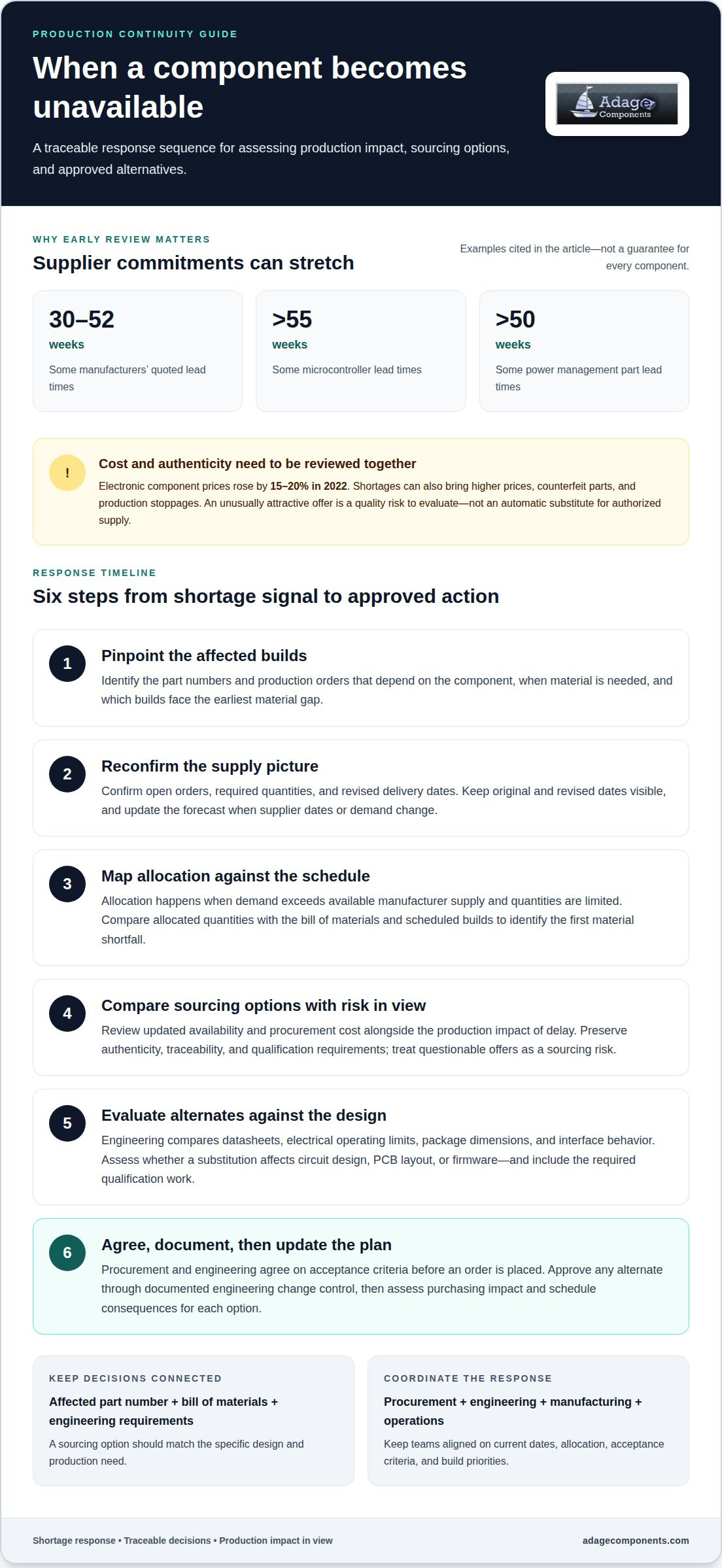
When a component becomes unavailable, first identify which production orders depend on it and when they need material. Some manufacturers quote lead times of 30 weeks to 52 weeks. Some microcontrollers exceed 55 weeks, while some power management parts exceed 50 weeks. These examples show why a forecast based on an earlier supplier commitment can quickly become unreliable. Confirm the affected part numbers, open orders, required quantities, and revised delivery dates before changing build plans.
Allocation adds another constraint. It occurs when demand exceeds a manufacturer’s available supply, prompting manufacturers or authorized distributors to limit customer quantities. Compare allocated quantities with the bill of materials and scheduled builds, then determine which production orders face the earliest material gap. Update the forecast when demand, supplier dates, or allocation changes. Keep original and revised dates visible so purchasing, manufacturing, and operations work from the same schedule.
Short supply can also increase procurement costs and expose buyers to questionable sourcing offers. Electronic component prices rose by 15-20% in 2022, while shortages can also lead to higher prices, counterfeit parts, and production stoppages. Treat an unusually attractive offer as a quality risk, not an automatic substitute for authorized supply. Evaluate the cost of a delayed build alongside the component quote, but preserve authenticity, traceability, and qualification requirements in any sourcing decision.
Redesign can reduce dependence on a constrained part, but an alternate must meet the circuit’s electrical and physical requirements. Engineering can compare datasheets, operating limits, package dimensions, and interface behavior, then assess whether a substitution changes circuit design, PCB layout, or firmware. For example, a replacement with a different package may require a board-layout revision, while a change in device behavior may require firmware testing. Approve the alternate through documented engineering change control before using it in production.
Set a traceable sequence for shortage response. Identify the constrained part and its impact on builds, request updated delivery information, and compare approved alternatives. Then assess qualification work, purchasing impact, and schedule consequences for each option. A supplier may provide sourcing options, but procurement and engineering should agree on the part’s acceptance criteria before an order is placed. This process helps teams respond to changing forecasts without treating every delayed line item as interchangeable.
For recurring component challenges, an electronic component line card can help teams identify relevant part categories for sourcing discussions. Use it alongside the affected bill of materials and engineering requirements, so availability decisions remain connected to the specific design and production need.
3. Sourcing obsolete and hard-to-find components
For an obsolete or constrained part, start with its exact manufacturer part number, approved revision, and application. Search across qualified suppliers and distribution channels, then compare offered stock against required quantity, date codes, packaging, and traceability records. A global sourcing network can widen the pool of potential sources, but each source still needs a documented review. Distributors specializing in obsolete or hard-to-find components may help locate stock when standard channels cannot meet production needs. Record the source and evidence for every purchased lot.
Dual sourcing builds resilience by maintaining at least two approved suppliers for critical components. It can reduce dependence on one manufacturer or channel, but adds supplier qualification work, order coordination, and potential minimum-inventory commitments. Strategic stockpiling can protect production against supply interruptions, but ties up working capital and creates exposure to aging or unused inventory. Choose between these approaches based on the component’s production impact, replenishment uncertainty, storage needs, and the time required to qualify an alternative. A combined approach may suit parts with long replacement cycles.
Grey-market sourcing requires particular care. The grey market includes parts sold outside the manufacturer’s authorized distribution network, including genuine surplus or excess inventory. However, components may have been stored incorrectly, handled without adequate electrostatic protection, or supplied without reliable traceability. These gaps make authenticity and condition harder to assess. Use vetted suppliers that can provide traceability and support authenticity testing. Maintain a counterfeit avoidance plan, and document acceptance criteria before buying from an independent source.
Qualify alternatives through a controlled engineering review. Compare manufacturer datasheets and confirm electrical characteristics, package dimensions, operating limits, and interface requirements against the original design. Check that ECAD models match the actual component, then evaluate any effects on circuit design, PCB layout, firmware, or manufacturing processes. Test the candidate in the relevant application and document results, approvals, and revision control before adding it to the approved bill of materials. A matching part number family alone doesn’t establish interchangeability.
Suppliers and contract manufacturers can contribute by sharing sourcing options, inventory visibility, and supply-chain support. A supplier with obsolete-component expertise may uncover additional stock; a contract manufacturer can connect component needs with build schedules and material planning. Give both parties clear part numbers, approved alternatives, forecast changes, and traceability requirements. These relationships help teams act on comparable information instead of conflicting assumptions about available quantities. Keep qualification authority with engineering and procurement so urgency doesn’t bypass the controls that protect production.
4. Advance project planning and forecasting
Start shortage-risk planning while a project’s specifications and sourcing assumptions are still taking shape. Map each bill-of-materials line to its intended production date, supplier lead time, lifecycle status, and approved alternative. Compare those details with design and build milestones to identify procurement decisions that can’t wait. Assign an owner to each high-risk part, and record the decision needed, such as qualifying a substitute or reserving material. This makes mitigating electronic component shortages a defined project responsibility rather than a last-minute response.
Use ERP and material requirements planning systems to connect component demand with actual schedules. Keep bills of materials, inventory balances, open orders, and forecast revisions aligned. When customer demand or a build date changes, recalculate material requirements and purchasing dates. Separate confirmed orders from forecast demand so teams can see which commitments are firm and which may change. Procurement can then escalate a specific shortfall with its quantity, schedule impact, and required decision instead of circulating a general warning.
Finite capacity planning brings production constraints into material discussions. Compare component availability with equipment, labor, and scheduled demand, then examine how a delayed part affects other planned work. If a constrained component supports several products, assess which builds have the greatest operational priority and which schedule changes are feasible. Record the assumptions behind each revised plan. This helps operations avoid moving work to a period when production capacity or another required material is unavailable.
Make procurement planning responsive to lifecycle and design changes. Review end-of-life notices, approved alternatives, new part introductions, and component data alongside current project requirements. For each exposed part, document whether the team will continue sourcing it, qualify a replacement, or evaluate a last-time purchase. Compare manufacturer datasheets with trusted industry sources, and ensure ECAD models correspond to the components selected for the design. These checks support efforts to mitigate electronic component shortages by connecting design records to actionable purchasing decisions.
For advanced projects with long development cycles, involve engineering, procurement, and operations before the design is locked. Evaluate alternatives during design reviews, document qualification criteria, and align material plans with project milestones. Military projects may require long-term research and development and advance component ordering. Set review points around changes to specifications, supplier commitments, and production schedules. At each review, record the owner, current risk, decision deadline, and next action so the forecast remains useful as the project develops.
5. Causes of electronic component shortages
Electronic component shortages arise when demand, production capacity, materials, and trade conditions fall out of alignment. Limited material availability or reliance on a small number of manufacturers can leave buyers with few sourcing channels. Labor shortages and unexpected contingencies can also interrupt output. Manufacturers can forecast exposure by mapping critical bill-of-materials parts to suppliers, lifecycle status, demand forecasts, and production schedules. This part-level view helps teams spot vulnerabilities before a disruption reaches the build plan.
Demand can amplify the problem. Customers may increase orders because they expect shortages, pushing apparent demand above actual consumption. That surge can make constrained supply harder to allocate and encourage further precautionary buying. Compare orders and forecasts with actual usage, then investigate sharp changes before adjusting procurement quantities. Semiconductor demand also varies across product lines: microprocessors and certain memory chips were identified as continuing shortage drivers in 2025. A general market snapshot can therefore obscure pressure on specific components.
Manufacturing capacity is another constraint. Adding semiconductor capacity is expensive and can take years, so producers can’t quickly match sudden demand increases. A 2023 excess supply of electronic components excluded specialized and critical components for complex systems, illustrating why overall inventory conditions don’t guarantee availability of a particular part. Track the exact components your design requires, rather than assuming broad market supply reflects your bill of materials.
Geopolitical disruptions and adverse trade policies can affect production locations, sourcing routes, and distribution channels. Tariffs were identified as a major restriction to trade for 2025. Semiconductor-company mergers, reductions in low-margin product lines, and eliminated overlapping production can also change where parts are made or reduce available options. These forces may interact: a product-line reduction can tighten supply, while trade barriers complicate access to remaining sources. Review manufacturer, regional, and channel exposure together.
Forecasting works best when teams combine several signals. Monitor lifecycle status, supplier updates, market trends, customer demand, and geopolitical indicators alongside inventory and order data. Compare supplier forecasts with actual deliveries, and flag components whose demand or supply changes sharply. Use these signals to update shortage reports, evaluate alternate parts, and define clear escalation actions. This approach won’t predict every disruption, but it helps teams respond to identifiable risks before production is affected.
To connect component planning with sourcing options, review the electronic component line card against your bill of materials and identified supply risks.
Adage Components: Thick Film Chip Resistors
Adage Components helps OEMs and EMS providers source authentic components through direct, verified procurement channels. We offer Thick Film Chip Resistors, Thin Film Precision Resistors, Carbon Film Resistors, and MELF Resistors, with manufacturer pricing and OEM pricing designed to deliver one of the best costs in the industry. Our partner suppliers include many franchised by top 100 distributors, and manufacturing audits support quality assurance.
We support commercial and automotive grade components, with international logistics designed to integrate with your MRP system and deliver to your facility on time. For resistor sourcing that fits your bill of materials, contact Adage Components.
Turn sourcing insight into your next procurement decision
Make your next sourcing review actionable by selecting one at-risk bill-of-materials line and assigning owners for its forecast, supplier records, and escalation decisions. Document the next step and decision deadline so mitigating electronic component shortages becomes part of routine procurement planning.
Then align sourcing options with your approved requirements. Use the component line card to compare relevant categories with your bill of materials and identify a focused next step for your sourcing review.
A clear decision record gives engineering, procurement, and operations a shared path forward. Start with one exposed component, establish ownership, and build from there.
Frequently Asked Questions
Electronic Component Shortages - What To Do When Parts Become Unavailable?
First, determine which builds are affected and what usable material is already available. Reconcile warehouse stock with work in progress, incoming shipments, and inventory held for other orders. Then ask the supplier for an updated delivery commitment and quantity, and identify the earliest production order at risk. Keep the original component in the approved design until engineering authorizes a change. An urgent purchasing decision shouldn’t bypass technical controls.
What about the grey market?
The grey market can provide access to surplus or excess components outside the manufacturer’s authorized distribution network, but the source path may be harder to establish. Assess each lot separately. Review the seller’s traceability records, storage and handling history, packaging, and inspection evidence before accepting material. Use this route only within your organization’s counterfeit avoidance and quality procedures, with clear criteria for rejecting a lot.
What issues could you expect?
A shortage can disrupt build schedules, reduce available production quantities, increase procurement costs, and create pressure to accept unverified parts. It can also force engineering changes if a substitute requires circuit, board-layout, or firmware revisions. For example, a delayed component may leave other parts purchased for the same assembly unused until production resumes. Track the impact across material, schedule, and design records so a local shortage doesn’t become an unmanaged production problem.
Why is allocation happening?
Allocation occurs when demand for a component exceeds the manufacturer’s available supply, so the manufacturer or an authorized distributor limits the quantities supplied to customers. A buyer may receive less than requested even with an open order. Compare allocated quantities with the needs of each scheduled build, then document which orders have priority. This makes the production impact visible and helps teams avoid assuming that an order confirmation guarantees full delivery.
What strategies help manufacturers reduce dependence on single-source electronic components?
Reduce single-source exposure by reviewing critical bill-of-materials parts for qualified alternatives and additional suppliers. Engineering can assess substitutes during design reviews, before urgent production changes are needed. Procurement can compare sources across manufacturers, regions, and distribution channels while maintaining consistent qualification records. For a part with no practical substitute, document the risk, responsible decision-makers, and escalation route so teams know how to respond if supply changes.
How much inventory should manufacturers hold to mitigate component shortages?
Set inventory levels by component risk and replenishment conditions rather than applying one blanket buffer to every part. Consider demand variability, supplier lead-time reliability, the production impact of a stockout, shelf-life or lifecycle concerns, and the time needed to qualify an alternate. A critical part with few sources may justify more protection than an easily replaceable item. Revisit the target as forecasts, supplier commitments, and design requirements change.
What are the risks of buying electronic components on the gray market?
Grey-market purchases can create uncertainty about authenticity, handling, storage, and traceability. A component may be genuine yet still have been stored or transported in conditions that compromise its suitability. Incomplete records can also make a suspect lot difficult to investigate or trace through production. Inspection can help identify issues, but it can’t eliminate every risk. Keep purchasing records linked to lot identification and the organization’s acceptance decision.
How can manufacturers verify the authenticity and quality of hard-to-source components?
Start with a documented supplier and lot review. Compare part markings, packaging, date or lot information, and available chain-of-custody records with purchase documentation and manufacturer data. Use qualified testing and inspection processes appropriate to the component and its application, and retain the results with the lot record. Require engineering and quality approval before release to production. No single inspection result replaces source evaluation and traceability controls.
Disclaimer
Cross-referenced components needs to be confirmed by the client with either spec. sheet or samples or both.
Please note, we use AI to help us, information is verified to be correct but we can not guarantee 100% accuracy.


