

A matching capacitance, voltage rating, and case size don’t make a standard commercial MLCC a safe substitute in an automotive application. AEC-Q200 qualification doesn’t transfer between manufacturers or between series from one manufacturer, so sourcing drop-in alternatives for standard MLCC part numbers requires checking the candidate’s own qualification and getting approval before substitution.
When an approved MLCC is constrained, a readily available alternative may seem like a practical way to protect production. But dielectric behavior, effective capacitance under bias, temperature performance, and reliability grade all affect whether a replacement performs as intended.
This guide explains how to assess MLCC alternatives, choose a suitable dielectric, compare key specifications, and route a candidate for approval. It also explains why a standard commercial part may not be an appropriate replacement for an automotive-grade MLCC.
Key Takeaways
- Treat a matching part number, package, or rating as a starting point, not approval. Automotive substitutions need the appropriate qualification and approval for the specific candidate.
- Choose X5R, X7R, or C0G/NP0 based on circuit temperature, stability needs, and effective capacitance under operating bias.
- Assess authorized distributors, manufacturers, and independent suppliers by how well their sourcing and traceability support your component requirements.
- Compare the complete specification set, including tolerance, dimensions, temperature behavior, and reliability grade, before approving a replacement.
- Use manufacturer cross-references to identify potential second sources, then evaluate each candidate against the original part’s requirements.
Approved vendor lists and alternative part approval
An approved vendor list (AVL) defines which manufacturers and part numbers a production program may use. A matching capacitance and voltage rating don’t automatically make an MLCC an approved substitute. For automotive assemblies, qualification applies to the specific candidate: AEC-Q200 status doesn’t transfer between manufacturers or between series from one manufacturer. A standard commercial capacitor therefore isn’t an automatic replacement for an automotive-grade part. A controlled process for sourcing drop-in alternatives for standard MLCC part numbers must link candidate evaluation to application requirements.
Keep sourcing and engineering decisions connected. When an MLCC shortage threatens delivery or scheduled orders, procurement can identify candidates while engineering and quality assess their fit for the application. A part that matches the footprint may still differ in temperature behavior, effective capacitance under bias, reliability grade, or manufacturing source. Those differences can affect circuit performance and program acceptance. Track sourcing drop-in alternatives for standard MLCC part numbers through evaluation and approval; don’t treat availability as proof of technical equivalence.
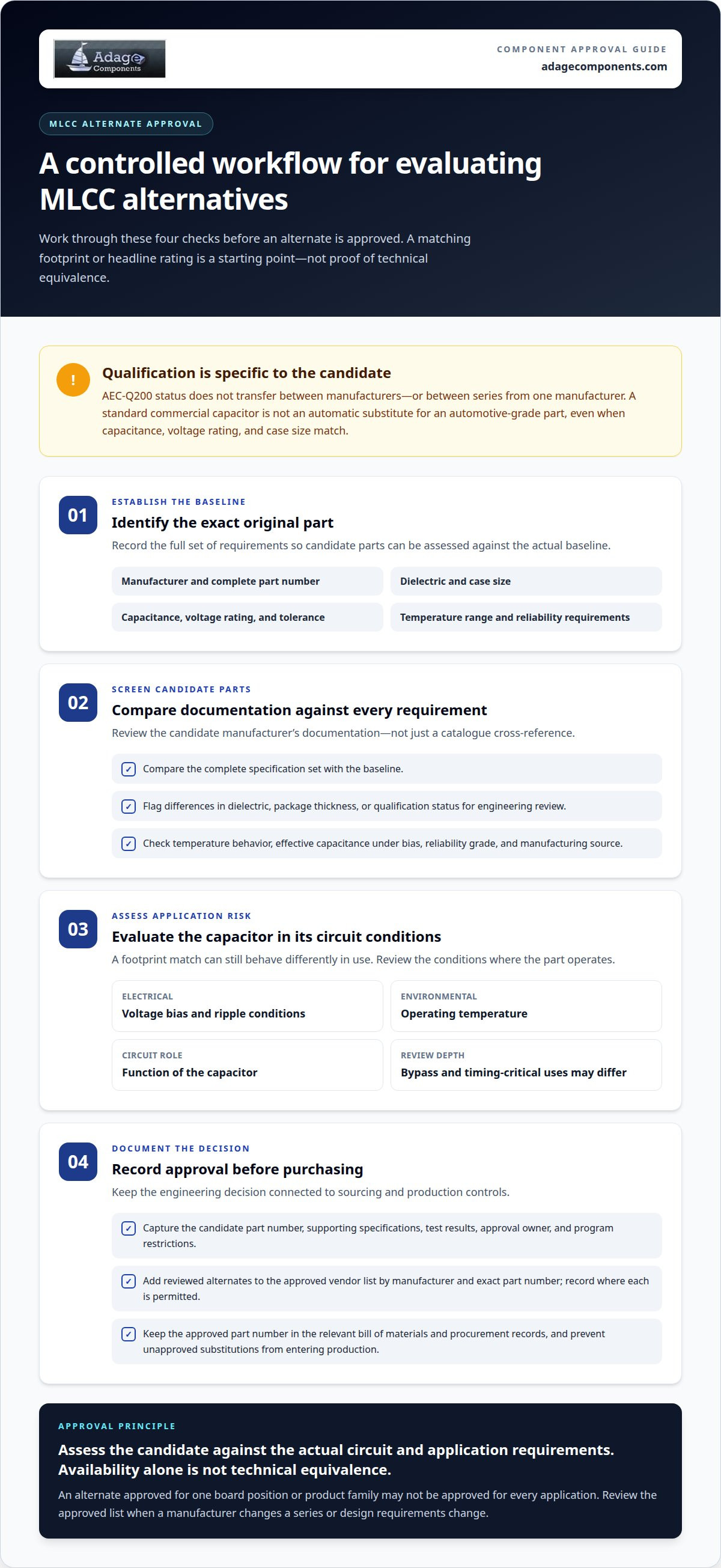
A controlled alternate-approval workflow helps buyers act quickly without treating availability as technical equivalence:
- Identify the exact baseline. Record the manufacturer, complete part number, dielectric, case size, capacitance, rating, tolerance, temperature range, and reliability requirements.
- Screen candidate parts. Compare manufacturer documentation against each baseline requirement. Flag differences such as dielectric, package thickness, or qualification status for engineering review.
- Assess application risk. Determine where the capacitor operates, including voltage bias, temperature, ripple conditions, and circuit function. A bypass capacitor and a timing-critical capacitor may require different review depth.
- Document the decision. Capture the candidate part number, supporting specifications, test results, approval owner, and any program restrictions before releasing it for purchasing.
Qualify an alternate against the actual circuit, not just a catalogue cross-reference. For example, an automotive control-board candidate needs review against the board’s operating conditions and automotive-grade requirements. Don’t treat a commercial-grade equivalent as qualified just because its capacitance, package, and voltage rating match. Qualification evidence must apply to the specific candidate part and series.
Expand the approved vendor list before a shortage forces an emergency change. Add technically reviewed alternates by manufacturer and exact part number, then record where each is permitted. A part approved for one board position or product family may not be approved for every application. Review the list when a manufacturer changes a series or design requirements change.
Connect approval to purchasing controls. Ensure the approved part number appears in the relevant bill of materials and procurement records, and prevent unapproved substitutions from entering production. This maintains traceability from the engineering decision through delivery, even when buyers must respond to changing supply conditions.
X5R, X7R, and C0G/NP0 dielectric selection
Dielectric choice determines how an MLCC’s capacitance changes with temperature and applied voltage. X5R operates from -55°C to +85°C, while X7R operates from -55°C to +125°C. X7R capacitance can vary by up to ±15% across that temperature range. C0G/NP0 is designed for greater stability, with drift within 0 ±30 ppm/°C from -55°C to +125°C. Select according to the circuit’s operating conditions, not simply the original part’s nominal capacitance.
Consider a 10 µF, 25 V, 0805 capacitor. An X7R original and an X5R replacement share those headline specifications, but their temperature ranges differ. If the board operates above +85°C, X5R falls outside its stated range. X7R may fit that temperature requirement, but its capacitance still varies across the range. C0G/NP0 offers stability, but its suitability depends on the required capacitance and circuit function. Engineering should evaluate those conditions together.
Rated voltage also affects usable capacitance. A ceramic capacitor’s effective capacitance can drop by over 50% when a 10 µF part operates near its maximum voltage rating. That change can leave a replacement below the circuit’s required capacitance, even when its printed value matches. Compare capacitance under the actual DC bias, not just the nominal value. A higher voltage rating may change the candidate’s size or availability, so evaluate the complete part.
Y5V presents a separate substitution risk. These capacitors can lose up to 82% of their capacitance at extreme temperatures. A Y5V part’s nominal value therefore may not represent its performance in a demanding circuit. Don’t replace X5R, X7R, or C0G/NP0 with Y5V based on capacitance alone. Review temperature exposure, voltage bias, and the minimum capacitance the circuit needs.
Counterfeit, obsolete, or non-compliant replacement MLCCs may have inaccurate markings, unreliable specifications, or incomplete traceability. These issues can undermine circuit performance and make it harder to establish whether a part meets automotive or other application requirements. Review manufacturer documentation and verify part identity as part of the substitution assessment.
Use this selection sequence: identify the circuit’s temperature range and applied voltage; determine the minimum effective capacitance required; then screen dielectric candidates against both conditions. For a 3.3 V indoor control board, X5R may suit the temperature requirement, but bias behavior still matters. On a board operating at 105°C, X7R or another suitable high-temperature dielectric may be considered instead.
For sourcing, match each candidate’s dielectric and voltage behavior to the application before comparing delivery options. Procurement teams can use the capacitor manufacturer linecard when reviewing candidate component lines.
Authorized distributors, manufacturers, and independent suppliers
Source strategy affects component traceability, production continuity, and procurement options. Manufacturers provide product specifications and lifecycle information for their own MLCC series. Authorized distributors connect orders to manufacturer-approved channels and can provide inventory and shipment details. Independent suppliers may broaden access when standard channels cannot meet demand, but buyers need to assess the source and component evidence carefully.
To check availability, lifecycle status, and authorized distributor inventory, start with the exact manufacturer part number. Compare the manufacturer’s current product-status information with inventory and delivery details from authorized distributors, including quantity, shipment timing, and any allocation conditions. Treat a stock listing as a snapshot, not a reserved supply commitment.
Lead times can change the sourcing decision. MLCC lead times typically run about 6 to 8 weeks in a normal market, while constrained MLCC families are commonly reported at 26 to 40 weeks in 2026. That difference can affect production schedules, so procurement should evaluate delivery against the build plan and approved alternatives together.
Each channel plays a distinct role in an alternate-part search:
- Manufacturers: Use manufacturer documentation to confirm the exact series, electrical specifications, lifecycle status, and qualification information. A cross-reference is a candidate, not automatic approval.
- Authorized distributors: Request current stock quantity, expected ship date, and order conditions for the exact part number. Confirm whether the quoted inventory can support the required production quantity.
- Independent suppliers: Assess traceability documents, packaging, lot identification, and inspection records before purchasing. Keep source and lot details attached to the procurement record.
For example, if a manufacturer lists an MLCC as active but inventory is limited, compare the available delivery against the production requirement. Before approving a candidate from another source, review its component history and documentation. Availability alone doesn’t establish equivalence or suitability for the application.
Use a consistent record for every quote: manufacturer and complete part number, source type, quantity, quoted delivery, lifecycle status, and traceability documents. Separate confirmed stock from forecasted supply. This makes comparisons between authorized and independent channels clearer, especially when orders cover multiple production builds.
Connect procurement findings to engineering approval. Keep each candidate off the approved purchasing list until its specifications and application fit have been evaluated. If a part is obsolete, record its lifecycle status and assess redesign or an approved alternate. This process helps buyers respond to an MLCC shortage without letting a faster delivery option bypass product controls.
Specifications to verify before substitution
A replacement MLCC must meet the circuit’s electrical, mechanical, thermal, and application requirements. Compare the complete manufacturer specification, not just capacitance and voltage. Samsung Electro-Mechanics recommends comparing candidate electrical characteristics and tolerances. This can reveal differences that a matching part-number suffix or package description may conceal.
For U.S. sourcing, don’t assume RoHS or REACH alone defines compliance for every product. Establish the requirements for the finished electronics product, its destination market, customer specifications, and intended application. Keep relevant material declarations with the part record so procurement and engineering use the same compliance basis.
DC bias reduces the effective capacitance of many ceramic capacitors. The amount depends on the candidate’s dielectric, package, rated voltage, and applied voltage. Compare the manufacturer’s capacitance-versus-bias data at the circuit’s operating voltage. A matching nominal value can still deliver less usable capacitance in the application.
Compare these specifications side by side before approving a candidate:
- Electrical: capacitance, rated voltage, tolerance, DC bias behavior, ESR, and ripple current.
- Physical: case size, thickness, termination details, and packaging required by production.
- Environmental: operating temperature range and the circuit’s actual thermal conditions.
- Quality and use: reliability grade, automotive requirements where applicable, and the intended circuit function.
Check package dimensions and thickness against the board layout and assembly process. A candidate with a different height can create clearance or mechanical-interference problems even when its footprint matches. Confirm that its packaging also meets the production line’s handling and placement requirements.
Compare electrical behavior under actual circuit conditions. For example, a capacitor on a supply rail may face sustained DC bias, while a filtering position may also depend on ESR and ripple current. The circuit’s role determines the required performance, not just the original bill-of-materials description.
During a shortage or allocation event, procurement may face pressure to select a readily available component. Keep that sourcing decision separate from technical approval. Record the manufacturer’s exact part number, datasheet revision, key specification differences, application, and approval status. This creates a traceable basis for evaluating the candidate and prevents an availability change from silently changing the design.
Which manufacturers offer second-source equivalents for common MLCC part numbers?
There is no universal second-source list for every MLCC part number. Murata, Samsung Electro-Mechanics, Taiyo Yuden, and Walsin are manufacturers to include in a candidate search. Each may offer parts worth evaluating, but equivalence depends on the exact electrical, mechanical, temperature, and qualification requirements.
Start with the original manufacturer and complete part number. Use its product documentation to identify the capacitor’s series and specifications, then search other manufacturers’ catalogues for candidates with comparable characteristics. A cross-reference can suggest options, but it doesn’t establish that a substitute meets the circuit’s needs or is approved for production.
Keep the comparison specific. For example, assess a Samsung Electro-Mechanics candidate against the original Murata part using both manufacturers’ documentation. Compare capacitance, rated voltage, dielectric, tolerance, package dimensions, temperature performance, and behavior under DC bias. A similar catalogue description is a screening aid, not proof of drop-in compatibility.
Build a structured shortlist rather than choosing a manufacturer by name alone:
- Define the baseline: Capture the complete original part number, series, application, and required performance.
- Search manufacturer portfolios: Review candidate series from Murata, Samsung Electro-Mechanics, Taiyo Yuden, and Walsin.
- Compare documentation: Record specification differences and identify any missing evidence needed for engineering review.
- Route candidates for approval: Keep each alternate distinct by manufacturer and exact part number in the qualification record.
For automotive use, manufacturer identity alone doesn’t establish qualification. AEC-Q200 status doesn’t transfer between manufacturers or between series from one manufacturer. Evaluate the exact candidate’s qualification and the application’s requirements before treating it as an automotive second source. A commercial-grade part isn’t an automatic replacement for an automotive-grade MLCC.
Availability also affects the shortlist. A manufacturer may offer a technically suitable series that cannot support the required order or delivery schedule. Keep sourcing status separate from engineering equivalence: procurement can track candidate availability while engineering evaluates suitability and approval. Revisit the shortlist when lead times, lifecycle status, or production requirements change.
The practical answer is to evaluate manufacturers’ specific series, not assume one brand offers a universal counterpart. Match candidates to the original part’s requirements, document differences, and obtain the required approval before release. To identify candidate component lines for your sourcing review, review the MLCC manufacturer linecard.
Adage Components: Multilayer Ceramic Capacitors (MLCC)
Adage Components supplies Multilayer Ceramic Capacitors (MLCC) for OEMs evaluating alternatives and managing component costs. We offer manufacturer pricing and OEM pricing, with one of the best costs in the industry and the same advantages as buying from tier 1 distributors but at OEM pricing. Our sourcing focuses on authentic components from vetted manufacturers and partner suppliers, many franchised by top 100 distributors.
We support commercial and automotive grade components and compliance with all ISO certifications. Our international logistics program and growing state-of-the-art warehouse support short lead times and integration with your MRP system, helping coordinate delivery to your facility in real time, on time. We also offer Thick Film Chip Resistors and Thin Film Precision Resistors.
Contact Adage Components to discuss your MLCC sourcing requirements.
Build a stronger sourcing path for your next production cycle
Use each substitution decision to strengthen future procurement planning. Keep approved alternatives tied to their exact applications and part numbers, then revisit the list when design requirements or supply conditions change. This makes sourcing drop-in alternatives for standard MLCC part numbers a repeatable process rather than a scramble during a shortage.
For a broader bill-of-materials review, consider component needs alongside the MLCC decision. Adage Components also offers Thick Film Chip Resistors, Thin Film Precision Resistors, and Carbon Film Resistors. Coordinated component sourcing can help keep related procurement requirements visible as production plans evolve.
Explore the available MLCC options and identify candidates for your sourcing review. Review Adage Components’ MLCC product line and take the next step toward a more resilient supply plan.
Frequently Asked Questions
Can I use standard MLCCs in an automotive application if AEC-Q200 parts are out of stock?
Not automatically. A standard commercial MLCC isn’t an equivalent automotive part just because its capacitance and voltage rating match. AEC-Q200 qualification applies to the specific manufacturer and series, so it doesn’t transfer to another candidate. Keep the automotive requirement in place, assess a proposed alternative against the application, and route it through your organization’s engineering and quality approval process before production use.
What Should Buyers Do Now?
Prepare a controlled alternate list before a shortage forces a rushed choice. Ask engineering to define acceptable specification ranges and identify candidates for review. Procurement can then track each exact part number, source, lifecycle status, quoted delivery, and order quantity in one record. Keep unapproved candidates separate from released purchasing options, and update production plans as confirmed supply information changes.
What Technical Specifications Must Be Matched When Cross-Referencing MLCC Drop-In Replacements?
Match the requirements that determine circuit operation and physical fit: capacitance, rated voltage, tolerance, dielectric, case size, thickness, temperature range, DC bias behavior, ESR, and ripple current. Also account for reliability grade, packaging, and application requirements. A candidate’s nominal capacitance alone doesn’t show whether it will deliver the required performance in the actual circuit.
What makes an MLCC a drop-in replacement for a standard part number?
A candidate is a practical drop-in only if it meets the application’s electrical and physical requirements without an unapproved design change. Its package must suit the board layout, and its operating characteristics must satisfy the circuit. A catalogue cross-reference identifies a possible candidate; engineering evaluation and approval establish whether it can replace the original in that specific position.
Which electrical and mechanical specifications must match when sourcing replacement MLCCs?
Check capacitance, voltage rating, tolerance, dielectric, temperature behavior, DC bias, ESR, ripple current, case dimensions, and thickness. Confirm the required reliability grade and packaging as well. For example, a capacitor that fits the board footprint may still differ in thickness or effective capacitance under operating bias. Compare it with the original part’s circuit role and physical constraints.
How to cross-reference MLCC part numbers across manufacturers?
Start with the complete original part number and its manufacturer documentation. Search other manufacturers’ catalogues for candidates, then compare each datasheet against the original requirements. Treat manufacturer cross-reference tools as a shortlist, not as approval. Record differences by exact part number and submit candidates for the relevant engineering review. A similar series name or headline rating doesn’t establish equivalent performance.
How do MLCC voltage rating, capacitance tolerance, dielectric, and case size affect interchangeability?
Voltage rating and applied DC bias influence effective capacitance, while tolerance defines the allowed variation around nominal capacitance. Dielectric affects temperature stability and capacitance behavior. Case size affects board fit and can influence performance. Together, these factors determine whether the replacement meets the circuit’s operating needs. Compare the candidate under the application’s operating conditions, not only by its printed value.
How to compare MLCC datasheets and verify package dimensions and termination compatibility?
Compare datasheets field by field, using the same units and conditions for each part. Review the package drawing for length, width, thickness, and termination layout, then compare these with the PCB land pattern and assembly constraints. Check the termination information against the design requirements. Record the datasheet revision and candidate part number so engineering and procurement review the same specification.
Disclaimer
Cross-referenced components needs to be confirmed by the client with either spec. sheet or samples or both.
Please note, we use AI to help us, information is verified to be correct but we can not guarantee 100% accuracy.


