

A capacitor’s voltage rating alone can’t tell you whether it belongs across the line or from line to ground. That distinction is central to safety capacitor Class X vs Class Y selection because a failure in the wrong circuit position can create a fire or electric-shock hazard.
When comparing the two classes, start with where the capacitor sits in the circuit and what could happen if it fails. Class X capacitors are used across line conductors. Class Y capacitors are used where a failure could compromise an insulation boundary, such as between line and ground. The right choice also depends on the design requirements and the component’s approved ratings, not just its class label.
This guide explains how circuit position and fault consequences distinguish Class X from Class Y, then shows how to narrow the choice to a suitable subclass using documented requirements and product information. You’ll also learn what to check when sourcing authentic, safety-certified components from vetted manufacturers, so the selected part aligns with the design and its procurement records.
Key Takeaways
- Map the capacitor’s connections to circuit conductors, ground, and any insulation boundary before choosing a class.
- Use potential fault consequences to guide safety capacitor Class X vs Class Y selection. Don’t treat the classes as interchangeable.
- Compare X1, X2, Y1, and Y2 with the equipment design requirements and the exact component’s datasheet.
- Follow a documented selection process: identify the connection, define the safety boundary, establish ratings, and verify approvals.
- Retain the exact part number, class marking, datasheet, and approval information in procurement records.
Class X vs. Class Y Safety Capacitors: What Each Class Protects
Start with the circuit connection, not the part label. The capacitor’s position and safety function determine whether the design calls for Class X or Class Y. A safety capacitor is qualified for specified positions in mains-connected equipment, where its connection affects the electrical and safety requirements it must meet. In general, Class X capacitors connect across line conductors, while Class Y capacitors connect between a line conductor and ground or across a designated safety insulation boundary.
That distinction makes safety capacitor Class X vs Class Y selection a circuit-level decision. The Safety capacitor Wikipedia article provides an overview of the categories and their use in mains circuits. For an actual part choice, follow the equipment design requirements and the selected component’s documentation.
Where Class X and Class Y Capacitors Connect
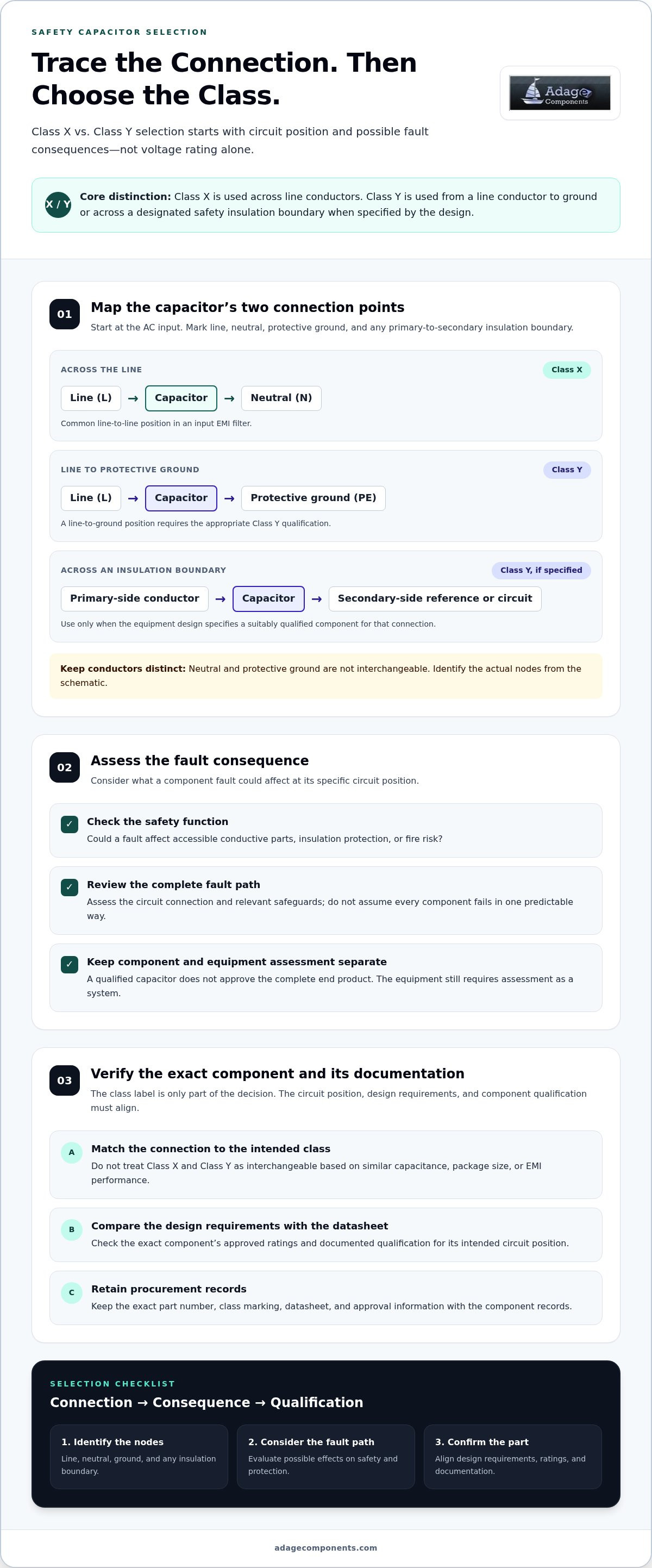
In an EMI filter, an across-the-line capacitor is placed between the incoming AC conductors, typically line and neutral. A Class X capacitor occupies this line-to-line position. A Class Y capacitor is used from a line conductor to protective ground, or across an insulation boundary when the equipment design specifies a suitably qualified component for that connection.
- Across the line: Line (L) → Class X capacitor → Neutral (N)
- Line to ground: Line (L) → Class Y capacitor → Protective ground (PE)
- Across an isolation boundary: Primary-side conductor → Class Y capacitor, if specified → Secondary-side reference or circuit, separated by the boundary
These examples describe connection roles, not a complete filter or isolation design. Neutral and protective ground are distinct conductors. Don’t treat them as interchangeable just because both may appear near the input stage. A line-to-ground connection and a connection across primary-to-secondary isolation can also have different design implications. Identify the actual nodes and boundary in the equipment schematic before assigning a capacitor class.
Why the Class Matters to the Design
Placement determines which electrical stresses, safety criteria, and component qualifications apply. The class marking is therefore not a general quality label. It indicates the capacitor’s intended circuit position. Don’t assume a Class X part is suitable for a Class Y position, or vice versa, based only on similar capacitance or package size.
Fault consequences are part of the engineering decision. Consider how a component fault could affect accessible conductive parts, insulation protection, or fire risk in the equipment. This is a design assessment, not a prediction that a particular capacitor will fail in a specific way. The intended connection, applicable requirements, and component documentation must align.
Component-level qualification does not approve the complete end product. The equipment design must still be assessed as a system, including its layout, insulation boundaries, and other relevant safeguards. Keep those responsibilities distinct: select a suitably qualified capacitor for its circuit position, then evaluate the finished equipment against its applicable requirements.
How Circuit Position and Fault Consequence Shape Capacitor Selection
Trace the electrical path before choosing a component. Start at the AC input and mark line, neutral, protective ground, and any point where primary and secondary circuits are separated by an insulation boundary. Then identify the capacitor’s two connection points. This makes the decision explicit: safety capacitor Class X vs Class Y selection depends on both where the component connects and what hazard its failure could create in that location.
Evaluate the connection and potential fault consequences together. A capacitor across line and neutral has a different safety role from one connected between a live conductor and ground or placed across a protective separation. Similar capacitance, footprint, or EMI performance doesn’t make the classes interchangeable. The applicable equipment requirements and the component’s documented qualification must match the actual circuit connection.
Class X in Across-the-Line EMI Filtering
In an input filter, a Class X capacitor connects between the AC line conductors, commonly line and neutral. At a high level, it helps suppress differential-mode interference, which appears as unwanted noise between those conductors. The capacitor remains on the same side of the circuit’s isolation boundary; it doesn’t bridge primary and secondary circuits. Confirm its position from the schematic and layout, not from proximity to an isolation barrier.
Class Y Across Line-to-Ground or Isolation Boundaries
A line-to-ground connection or a position crossing a safety boundary calls for the appropriate Class Y qualification. The design must account for the risk that a fault could compromise separation from accessible or otherwise protected circuitry. A Class Y capacitor is one qualified component in that arrangement, not a substitute for the equipment’s complete insulation design, required spacing, or other protective measures.
Fault analysis should focus on consequences, not assumptions that every component will fail in one predictable way. Ask what could happen if the capacitor loses its intended electrical properties: could the result affect fire risk, protective separation, or shock protection? Class distinctions address different safety functions, but the equipment designer must assess the complete fault path and safeguards. Don’t infer suitability solely from a class marking or assume a component can compensate for inadequate system-level insulation.
Document the reasoning alongside the circuit requirements. A useful design record links the capacitor’s terminals to named nodes, identifies whether it crosses a protective boundary, and records the required component class and supporting approval information. The IEC standards for safety capacitors provide the broader standards framework. Apply the requirements relevant to the equipment and its intended market rather than relying on a schematic symbol alone.
For sourcing, include the approved circuit position and required class in the component specification. Adage Components’ capacitor product categories can help connect that documented design need to relevant Class X and Class Y capacitor offerings.
Class X1, X2, Y1, and Y2: Compare Ratings Before Choosing
After identifying the capacitor’s circuit position, compare subclasses within the correct class. X1 and X2 apply to across-the-line positions; Y1 and Y2 apply to line-to-ground or other specified safety-boundary positions. Their designations distinguish rating requirements, including impulse withstand capability. They don’t rank every safety capacitor on one universal scale, and a higher-looking number in one class doesn’t establish suitability in the other.
The table provides a screening framework, not a substitute for a component specification. Exact rating thresholds and application conditions depend on the applicable standard and the individual part’s documentation. For defensible safety capacitor Class X vs Class Y selection, match the subclass to the equipment design requirements first, then verify the exact component ratings.
What the Subclass Tells the Design Engineer
A subclass identifies a defined rating category within its own class. Compare X1 with X2 only for an appropriate Class X circuit position, and Y1 with Y2 only for an appropriate Class Y position. The categories relate to electrical stresses such as impulse withstand. They don’t, by themselves, specify capacitance or prove a part is suitable for every circuit in that class.
| Subclass | Placement | Rating basis | Datasheet checks |
|---|---|---|---|
| X1 | Across line conductors | Class X impulse withstand category | Confirm rated AC voltage, exact class marking, approvals, and stated operating conditions. |
| X2 | Across line conductors | Class X impulse withstand category | Check that its documented rating and approvals meet the equipment specification. |
| Y1 | Line-to-ground or a specified insulation boundary | Class Y impulse withstand category | Verify the intended connection, rated AC voltage, approvals, and mounting details. |
| Y2 | Line-to-ground or a specified insulation boundary | Class Y impulse withstand category | Confirm that documented use matches the circuit position and design requirements. |
How to Read the Capacitor Datasheet
Read the complete part entry, not just the ordering description. Confirm that the printed safety-class marking and rated AC voltage match the design specification. Review approval marks and their stated scope, operating conditions, capacitance, package, and mounting details. Then check that the datasheet’s documented application corresponds to the actual circuit connection and boundary.
Don’t infer exact impulse thresholds or suitability from the subclass name alone. Verify those values against the current applicable standard and the manufacturer’s datasheet for the exact part number. If the design calls for an X2 part, for example, a similar capacitance in an X1-rated package isn’t automatically an acceptable replacement. The class, ratings, approvals, and physical implementation must all satisfy the design requirements.
Record the selected subclass and its supporting documentation with the component specification. This keeps engineering intent clear through review and procurement, and helps prevent a part with matching capacitance but the wrong safety rating from entering the approved design.
A Practical Class X vs. Class Y Selection and Verification Process
A repeatable review turns circuit intent into a traceable component choice. For safety capacitor Class X vs Class Y selection, follow the design specification and applicable standards, then verify the exact candidate part against its datasheet. A schematic symbol can show where a capacitor connects, but it doesn’t establish the required class, subclass, or rating.
Four Steps from Schematic to Candidate Part
- Mark the connection. Identify the capacitor’s two circuit nodes. Record whether it connects across line conductors or between a line conductor and ground or another side of an insulation boundary.
- Establish class and subclass. Use the equipment design specification and applicable standards to determine the required class and subclass for the documented operating conditions. Don’t infer them from capacitance, symbol, or physical location alone.
- Compare candidate ratings. Check rated voltage, capacitance, approvals, operating conditions, and package or mounting details against the circuit requirements. A candidate is suitable only if its documentation aligns with the intended connection and design criteria.
- Record the selection. Capture the exact manufacturer part number and retain its datasheet and approval information with the design review. This creates a traceable link between the circuit requirement and the component selected for procurement.
Keep the review sequence intact. If the documented connection or required class changes, reassess the candidate rather than carrying forward a part selected for a different position. This disciplined record also supports a stronger passive component sourcing strategy, linking engineering requirements to the exact part identified for procurement.
Design Checks Beyond the Capacitor Marking
A correct marking is only one part of the review. Evaluate the complete insulation strategy and applicable board-layout requirements, including creepage and clearance as defined by the equipment design. The capacitor’s classification doesn’t establish that the surrounding layout or end product meets its safety requirements.
Check derating and operating conditions against the design team’s criteria. Review the expected electrical environment and confirm that the selected component’s documented limits fit the application. Tie these checks to the actual part number. Don’t assume specifications for one component apply to another with a similar package or capacitance.
Final compliance decisions belong to the qualified equipment-design and safety-review process. Component selection supports that assessment, but it doesn’t replace system-level review. Preserve the requirement, candidate datasheet, and design rationale together so reviewers can see why the chosen part matches its circuit position.
Once the electrical and documentation requirements are defined, use Adage Components’ capacitor product line card to identify relevant Class X and Class Y capacitor categories for your sourcing process.
Source Safety-Certified Class X and Class Y Capacitors with Documentation
Procurement records should preserve the exact part number, class marking, datasheet, and approval information. This creates a traceable record of the component reviewed for the design and helps your team compare incoming parts against approved requirements. Adage Components offers Class X and Class Y capacitors and safety capacitors. These safety-certified capacitors are recognized by major safety agencies such as TUV, UL, CSA, and CQC. Check the documentation for the exact part to confirm its approvals and application.
We connect component sourcing with cost and supply-chain needs. Our partner suppliers include many franchised by top 100 distributors, and we support commercial and automotive grade components. We provide manufacturer pricing and OEM pricing, with the same advantages as buying from tier 1 distributors but at OEM pricing. Our direct, verified procurement channels support authentic components from vetted manufacturers, while our international logistics program is designed to support shorter lead times.
What to Include in a Component Sourcing Request
Make the request specific: include the schematic position, required class and subclass, electrical ratings, and approved part reference. Add package or mounting requirements that affect interchangeability. For a pin-for-pin replacement evaluation, provide the existing part number and request the relevant spec sheet and/or samples. These details give engineering and procurement a shared basis for reviewing a candidate.
Use the BOM submission form to provide component requirements and reference information. We support the sourcing process with authentic components from vetted manufacturers, while your engineering team retains responsibility for approving a component for its intended design.
Qualified Sourcing and the Next Design Step
We prioritize verified procurement and document-backed component selection. Our quality-assurance approach includes in-person manufacturing audits worldwide. Where supplier certifications apply, rely on the specific documented certifications for that partner and component. Don’t infer an approval from a supplier’s other product lines.
Keep the approved part reference and supporting documents together as the design moves into procurement. Review capacitor categories on the line card to align your documented requirements with relevant offerings. For a next step, explore safety capacitor sourcing options with Adage Components.
Carry the Approved Selection into Your Next Design Review
Make the capacitor decision part of a controlled design record. As a schematic evolves, retain the approved part reference and its supporting documentation alongside the circuit requirements. That gives engineering and procurement a consistent basis for reviewing substitutions or updates, without relying on guesswork. A disciplined safety capacitor Class X vs Class Y selection process helps keep component choice aligned with the intended application as the design moves toward production.
Use the next review to connect your documented requirements with the right component category. Adage Components supports sourcing for Class X and Class Y capacitors and safety capacitors, helping connect design requirements with procurement planning.
Review capacitor categories on the line card and take the next step toward a well-documented selection. Send Adage Components your capacitor requirements to support your sourcing process.
Frequently Asked Questions
Can a Class X capacitor be used in place of a Class Y capacitor?
No, not as a direct substitution. A Class X part is intended for a different circuit position from a Class Y part, so matching capacitance or package dimensions doesn’t establish equivalent safety suitability. For safety capacitor Class X vs Class Y selection, evaluate the proposed change against the equipment design requirements, applicable standards, and replacement part documentation. Record the rationale and obtain engineering approval before updating the approved component reference.
Is a Class Y capacitor always connected between line and ground?
No. Line-to-ground is a common Class Y application, but some designs place a suitably qualified Class Y capacitor across an insulation boundary. The schematic and equipment safety design define its intended role. For example, a capacitor between primary and secondary circuitry has a different connection context from one between line and protective ground. Trace the actual nets and boundary, then compare them with the part’s documented application.
What is the difference between Class X1 and Class X2 capacitors?
Both are Class X categories for across-the-line applications, but they represent different rating requirements, including impulse withstand capability. Don’t treat X1 and X2 as interchangeable based on the label alone, or assume one is suitable simply because its number appears higher. Compare the required category with the candidate’s rated AC voltage and documented conditions. For exact rating differences, consult the current applicable standard and the manufacturer’s datasheet.
What happens if a safety capacitor fails?
The outcome depends on the component, circuit, and surrounding protective design. A capacitor fault may interrupt its intended filtering function or affect insulation and safety protection. Possible consequences can include equipment malfunction, shock exposure, or increased fire risk. Don’t assume every part fails in the same way, or use a generic failure mode to justify a selection. Assess the specific fault path and equipment safeguards during design review.
How do I choose between a Y1 and Y2 capacitor?
Choose according to the documented requirements for the exact circuit position, not by comparing subclass numbers in isolation. Review the required voltage and impulse ratings, the insulation boundary, the equipment specification, and the applicable standards. Then confirm the candidate’s class marking, approvals, and operating conditions in its datasheet. Verify exact thresholds against current requirements and manufacturer documentation before approving the component for the design.
Are Class X and Class Y capacitors polarized?
Safety capacitors designed for AC applications are generally non-polarized, so they don’t have a positive and negative terminal like polarized capacitors. Still, don’t rely on appearance alone when installing or specifying a part. Check the datasheet for terminal, mounting, and connection instructions, and ensure the component is placed in the circuit position for which it’s qualified. Follow the equipment design’s wiring and layout requirements.
Which certifications should I look for on a safety capacitor?
Required approvals depend on the equipment, intended market, and exact component. Check the approval information in the datasheet for the specific part number, including the scope of each mark and any stated conditions. Compare that evidence with the equipment specification and applicable standards. A mark on one component or product family doesn’t establish approval for another part, nor does component approval by itself establish compliance of the complete product.
Disclaimer
Cross-referenced components needs to be confirmed by the client with either spec. sheet or samples or both.
Please note, we use AI to help us, information is verified to be correct but we can not guarantee 100% accuracy.


