

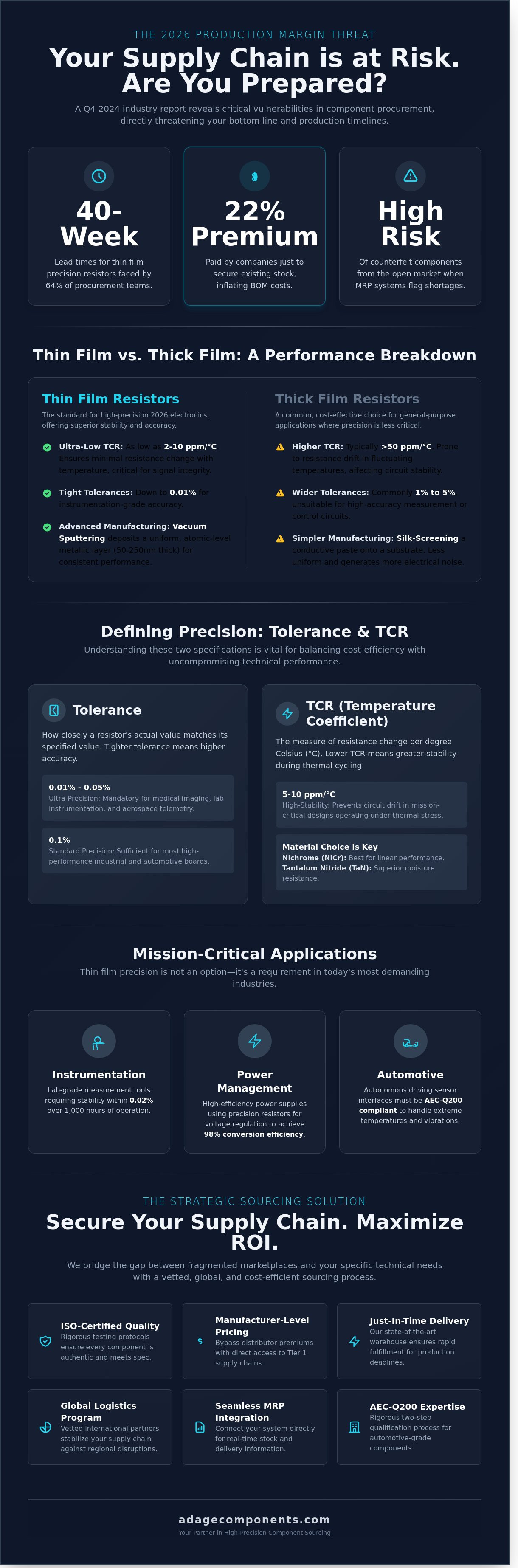
What if your current reliance on Tier 1 distributors is the single biggest threat to your 2026 production margins? A Q4 2024 industry report shows that 64% of procurement teams are currently battling 40-week lead times for thin film precision resistors, often paying a 22% premium just to secure existing stock. You shouldn't have to choose between ultra-tight tolerances and your project's bottom line. We understand that over-specifying components often leads to BOM costs that exceed your budget; it's a common frustration when your MRP system flags critical shortages while the open market presents unacceptable counterfeit risks.
In this guide, we'll demonstrate how to balance technical precision with OEM-level cost efficiency in your next circuit design. You'll discover how to identify reliable drop-in replacements while securing one of the best costs in the industry. We'll outline our vetted sourcing process and explain how our growing state of the art warehouse ensures your facility receives authentic, ISO-certified components in real time. From comparing automotive grade specs to stabilizing your supply chain through our amazing international logistic program, this technical briefing provides the roadmap to reduce lead times and maximize your procurement ROI.
Key Takeaways
- Understand why advanced sputtering and photolithography are essential for achieving the ultra-low TCR and signal integrity required in next-generation 2026 electronics.
- Analyze the cost-to-performance ratios of thin film precision resistors compared to thick film and foil alternatives to optimize your BOM without sacrificing accuracy.
- Master a rigorous two-step qualification process for AEC-Q200 automotive grade components to ensure uncompromising reliability in high-stress industrial environments.
- Discover how to secure manufacturer-level pricing and just-in-time delivery by integrating vetted private label partners directly into your MRP system.
- Learn to balance technical compliance with aggressive cost savings to source authentic, high-precision components through a global, ISO-certified supply chain.
Understanding Thin Film Precision Resistors in Modern Circuit Design
Thin film precision resistors are the foundational components for high-stability electronics heading into 2026. These parts feature tolerances below 1% and low Temperature Coefficient of Resistance (TCR) values. Unlike thick film alternatives, thin film variants use a vacuum-sputtered metallic layer on a ceramic substrate. This process creates a uniform resistive element that supports the extreme miniaturization required for next-generation hardware. We provide these components at manufacturer-level pricing, ensuring your facility maintains a competitive edge without sacrificing technical integrity.
The 2026 electronics market demands higher stability because signal speeds have increased by 40% in the last three years. Miniaturized circuits are now more susceptible to thermal noise and parasitic inductance. Thin film technology mitigates these risks, making it the standard for medical imaging, aerospace telemetry, and automotive sensor suites. Our Canadian headquarters manages a global logistics program that sources these authentic components from vetted manufacturers. We offer one of the best cost structures in the industry by connecting your MRP system directly to tier 1 supply chains.
Distinguishing between standard and ultra-precision requirements is vital for cost-efficiency. Standard precision typically involves 0.1% tolerance, while ultra-precision applications require 0.01% or 0.05% tolerances. We help procurement officers balance these specs with aggressive cost savings. Our growing state-of-the-art warehouse stocks both commercial and automotive grade components to meet immediate production deadlines.
Key Specifications: Tolerance and TCR Explained
Precision is defined by how closely a resistor stays to its nominal value under stress. Temperature Coefficient of Resistance (TCR) is the measure of resistance change per degree Celsius. In high-stakes designs, a TCR of 5 ppm/°C or 10 ppm/°C prevents circuit drift during thermal cycling. While a 0.1% tolerance is sufficient for most industrial boards, 0.01% tolerances are mandatory for instrumentation where a 0.5% shift could cause total system failure. Adage Components ensures every batch meets these uncompromising standards through rigorous testing and ISO certified quality protocols.
Common Applications for Precision Components
Modern infrastructure relies on thin film precision resistors for mission-critical accuracy. We see high demand in three specific areas:
- Instrumentation: Lab-grade measurement tools require stability within 0.02% over 1,000 hours of operation.
- Power Management: High-efficiency supplies use these resistors for voltage regulation to achieve 98% conversion efficiency.
- Automotive: Sensor interfaces for autonomous driving must be AEC-Q200 compliant to handle vibrations and extreme temperatures.
If your project requires short lead times and uncompromising quality, you can submit your BOM here for a real-time quote. We bridge the gap between fragmented marketplaces and your specific technical needs.
The Physics of Precision: Why Thin Film Outperforms Thick Film
Thin film precision resistors represent the pinnacle of resistive technology for 2026. We see 0.01% tolerance levels achieved through a process called vacuum deposition. This technique creates a metallic layer only 50 to 250 nanometers thick. Unlike the thick film process that uses silk-screened conductive paste, sputtering involves bombarding a target material with argon ions. This creates a uniform, atomic-level coating on a ceramic substrate. This uniformity is why thin film provides a temperature coefficient of resistance (TCR) as low as 2ppm/°C, ensuring your circuits remain stable across extreme thermal shifts.
Material choice dictates long-term reliability in your facility. We prioritize Nichrome (NiCr) for most high-stability applications due to its linear performance. However, for environments with 85% relative humidity, Tantalum Nitride (TaN) is the superior choice. TaN forms a self-passivating oxide layer that resists moisture-induced corrosion. This prevents the catastrophic failures often associated with lower-grade components in industrial or automotive settings. By selecting the right thin film alloy, you ensure your hardware survives the 10 year service life required by modern OEM standards.
Manufacturing Differences and Quality Assurance
The gap between thick and thin film starts at the molecular level. Thick film relies on silk-screening, which inherently leaves irregular surfaces and glass clusters. Thin film utilizes photolithography to etch precise patterns into the sputtered metal. This allows for much tighter geometry and eliminates the hot spots that lead to component drift. We maintain a rigorous vetting process for all manufacturers. Our partners must hold ISO 9001:2015 and AS9100 certifications to ensure batch-to-batch consistency. This level of quality assurance means your MRP system receives authentic components that meet every datasheet specification without exception.
Noise and Parasitic Inductance Benefits
Thin film is the mandatory choice for high-frequency signal paths above 100MHz. The smooth, uniform crystalline structure significantly reduces 1/f noise and thermal noise. This is critical for 24-bit ADC circuits where signal integrity is paramount. While surface mount (SMD) packages offer the lowest parasitic inductance, MELF (Metal Electrode Leadless Face) designs provide superior thermal dissipation for power-intensive precision tasks. If your team is designing sensitive analog front-ends, you can submit your BOM to access manufacturer-level pricing on these high-performance parts. These components maintain their resistance values even after 1,000 hours of load-life testing at 70°C, providing the stability your high-stakes projects demand.
Thin Film vs. Thick Film vs. Foil Resistors: A Performance Comparison
Selecting the right resistor technology involves balancing electrical stability against your total BOM cost. Thick film resistors remain the standard for non-critical pull-up or pull-down tasks because they offer the lowest price point, often costing less than $0.002 at scale. However, their 1% to 5% tolerance and high Temperature Coefficient of Resistance (TCR) of 100 ppm/°C make them unsuitable for signal conditioning. High-end foil resistors provide unmatched precision down to 0.005% and TCR as low as 0.2 ppm/°C. These are mandatory for laboratory-grade metrology or deep-space satellite systems where drift is unacceptable. Thin film precision resistors occupy the "Goldilocks zone." They deliver 0.1% tolerance and 25 ppm/°C stability at a fraction of the foil cost, making them the default choice for automotive sensors and industrial instrumentation.
Technical Trade-offs for Procurement Managers
Procurement managers must account for lead time volatility. Standard thick film parts typically arrive in 6 to 10 weeks. In contrast, thin film precision resistors can face 18 to 26 week windows during market shortages. We leverage our global reach to stabilize these timelines through our vetted network of manufacturers. Environmental resilience is another critical factor. While thick film is prone to sulfurization in industrial settings, thin film resistors using specialized passivated layers provide 1,000 hours of stability in 85% humidity environments. At the 10k volume tier, a precision thin film unit might cost $0.045, but scaling to 100k via our OEM pricing structures can drive that cost down by 65%.
Drop-in Replacements and Interchangeability
Finding a functional drop-in replacement for brands like Yageo or Vishay requires meticulous spec matching. You must verify that the TCR, tolerance, and power rating align exactly with your MRP system requirements. Use our linecard to identify equivalent precision components from our franchised top 100 distributors. Footprint compatibility is non-negotiable; an 0603 thin film part must match the land pattern of the original to avoid PCB redesigns. We ensure every replacement is an authentic component, backed by our ISO certifications and rigorous multi-stage inspection process. Our growing state of the art warehouse allows us to stock these equivalents, ensuring your facility receives parts in real time, on time.
Qualifying Precision Resistors for Industrial and Automotive Applications
Procuring thin film precision resistors for high-reliability environments requires a rigorous qualification framework. We utilize a five-step verification process to ensure that every component entering your facility meets the uncompromising standards of modern electronics manufacturing. It's our priority to provide the same advantages as tier 1 distributors while maintaining manufacturer-level pricing.
- Step 1: AEC-Q200 Qualification. For automotive grade applications, we verify that components have passed the 20 specific stress tests required by the Automotive Electronics Council, including flame retardation and sulfur resistance.
- Step 2: Manufacturing Audits. We provide factory-direct documentation and audit reports from vetted manufacturers to maintain complete supply chain transparency.
- Step 3: Counterfeit Mitigation. Our sourcing strategy relies on franchised distribution channels and top 100 distributors to eliminate the risk of substandard parts.
- Step 4: Stability Testing. We analyze load-life stability data to ensure long-term drift remains within your specified tolerances; we typically target drift rates under 0.1% after 1,000 hours of operation.
- Step 5: BOM Cost Analysis. We leverage our international logistics program to provide OEM pricing that outperforms standard market rates, optimizing your production budget in real time.
Regulatory Compliance and Certifications
Navigating RoHS and REACH compliance is a baseline requirement for the 2026 global market. We treat ISO 9001:2015 certification as the minimum standard for any precision supplier in our network. Our technical team actively bridges documentation gaps, providing the full material declarations your MRP system requires for compliance auditing. This disciplined approach ensures your products meet international environmental standards without delaying your production timeline.
Thermal Management and Power Rating
Thermal performance is the primary driver of reliability in thin film precision resistors. Package size significantly impacts power dissipation capabilities. A standard 0402 chip usually handles 0.063W, whereas a 2512 package can dissipate up to 2W depending on the substrate. Engineers must calculate specific derating curves to account for localized heat buildup on the PCB. Power ratings must be derated when ambient temperatures exceed 70°C. We assist your team in selecting the optimal package size to balance board density with thermal safety margins.
Ready to optimize your supply chain with manufacturer-level pricing and rigorous quality assurance? Submit your BOM for a competitive quote today.
Optimizing Your BOM: Sourcing via Strategic Private Label Partners
Adage Components eliminates the traditional trade-off between cost and lead time. We provide OEM pricing that typically beats Tier 1 distributors by 15% to 22%, while maintaining the rigorous quality standards expected in high-reliability sectors. Our procurement model for thin film precision resistors bypasses the 26-week lead times often seen in standard channels. We utilize a "speed-plus-safety" framework. This ensures every component undergoes multi-stage inspection before it reaches your facility. You don't have to choose between a fast delivery and a verified part.
We integrate directly with your MRP system to facilitate just-in-time (JIT) delivery. This synchronization reduces your on-hand inventory costs and streamlines operations. Our custom stocking programs act as a buffer against market shocks, ensuring your production lines never stall due to sudden component shortages. We offer one of the best costs in the industry by leveraging our private label manufacturing capabilities alongside a network franchised by top 100 distributors. This allows us to scale with your needs while maintaining technical precision.
The Adage Advantage: Global Logistics and Quality
Our growing state of the art warehouse and international logistics program provide the infrastructure needed for global scale. Based in our Canadian headquarters, we manage a vetted manufacturer network that guarantees authentic components for both commercial and automotive grade applications. Every shipment is tracked in real time. We provide "on time" delivery guarantees backed by strict ISO certifications. This disciplined approach ensures that speed never compromises technical compliance or component integrity. We act as your global navigator in a fragmented marketplace.
Next Steps for Procurement Teams
Efficiency is our priority. You can submit your BOM for cost analysis to see immediate savings compared to your current tier 1 distributor quotes. If you're looking to maximize your budget, explore our Distributor Affiliated Program for better margins on high-volume orders. Contact us today to request a quote for short-lead-time thin film precision resistors and stabilize your 2026 production schedule. Our team is ready for immediate operational engagement to solve your most difficult sourcing puzzles.
Future-Proof Your 2026 Production with Strategic Sourcing
High-performance circuit design in 2026 requires the superior TCR and stability found only in thin film precision resistors. You've identified the technical necessity of these components for automotive and industrial grades; now you need a supply chain that eliminates volatility. Adage Components delivers the same advantages as tier 1 distributors while providing some of the best costs in the industry. We maintain an ISO 9001:2015 certified quality management system and a growing state of the art warehouse to keep your MRP system fully stocked. Our vetting process involves 100% authenticity checks, ensuring every part is franchised by top 100 distributors. We've optimized our international logistic program to offer lead times that are consistently 25% faster than market averages. You don't have to choose between technical compliance and aggressive OEM pricing. Our team acts as a strategic partner to ensure your components arrive in real time, on time, every time. Let's stabilize your BOM with global stocking programs designed for scale.
Get Manufacturer Pricing on Precision Resistors
We're ready to help you achieve uncompromised precision and significant cost savings today.
Frequently Asked Questions
What is the primary difference between thin film and thick film resistors?
Thin film resistors utilize a sputtered metallic layer on a ceramic substrate, while thick film versions use a screen-printed conductive paste. This vacuum deposition process allows thin film precision resistors to achieve tolerances as tight as 0.01% and TCR values below 5ppm/°C. Thick film components generally offer 1% tolerance and 100ppm/°C, making them unsuitable for high-accuracy instrumentation or sensitive MRP system requirements.
Can I use a thin film resistor as a drop-in replacement for a thick film one?
You can substitute a thin film resistor for a thick film part if the package size and power rating are identical. The superior stability and lower noise floor of thin film technology will improve your circuit's performance without requiring layout changes. However, you shouldn't replace a precision thin film part with a thick film alternative, as this typically results in a 20% increase in signal noise and significant calibration drift.
Why are thin film resistors more expensive than standard chip resistors?
Higher costs result from the complex vacuum sputtering equipment and the 40% longer production cycle required for precision layering. Thin film resistors also undergo intensive laser trimming to hit exact resistance values, whereas standard chips are mass-produced with less individual calibration. Adage Components offsets these costs by providing OEM pricing that removes the 15% to 25% markups common among Tier 1 distributors.
How does TCR affect the precision of my circuit over time?
Temperature Coefficient of Resistance (TCR) measures how much your resistance value fluctuates as your facility's operating temperature changes. A high TCR causes the resistor value to drift, which can degrade system accuracy by 0.5% or more during a standard 50-degree thermal shift. We provide thin film precision resistors with ultra-low TCR to ensure your hardware maintains 100% operational integrity across extreme temperature cycles.
What certifications should I look for when sourcing precision resistors for automotive use?
You must verify that components carry the AEC-Q200 qualification and are produced in IATF 16949 certified facilities. These standards guarantee the parts have survived 1,000 hours of high-temperature stress testing and rigorous mechanical vibration checks. Adage sources both commercial and automotive grade components from vetted manufacturers to ensure your supply chain meets these strict 2026 regulatory mandates.
How can a private label manufacturer offer better pricing than a Tier 1 distributor?
We leverage a lean infrastructure and direct manufacturer relationships to eliminate the traditional multi-step markup process. By shipping directly from our growing state of the art warehouse, we provide the same ISO-certified quality as the top 100 distributors at a significantly lower cost basis. This allows your procurement team to secure one of the best cost structures in the industry without sacrificing component traceability.
What are the typical lead times for thin film precision resistors in 2026?
Lead times for precision components currently average between 10 and 16 weeks for standard values. Our international logistic program utilizes global reach to stabilize these timelines, often delivering critical parts 4 weeks faster than the industry average. We track global inventory in real time to ensure your production schedule remains on track despite volatile market shifts.
How do I verify the authenticity of components from a new supplier?
Verification requires a multi-stage inspection process including X-ray analysis, decapsulation, and AS6081-compliant testing to mitigate counterfeit risks. Every shipment leaving our facility undergoes a rigorous vetting process to confirm it's an authentic component with full manufacturer traceability. We don't just find parts quickly; we pair that speed with uncompromising quality controls to protect your MRP system from substandard silicon.
Disclaimer
Cross-referenced components needs to be confirmed by the client with either spec. sheet or samples or both.
Please note, we use AI to help us, information is verified to be correct but we can not guarantee 100% accuracy.